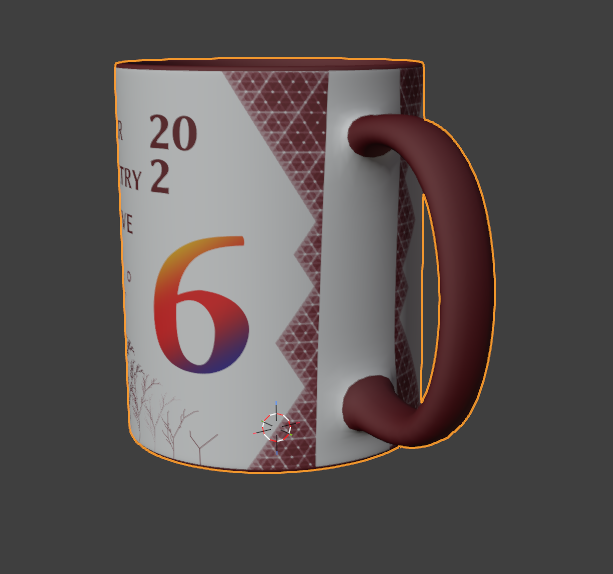
Hello, my name is Oras, and I am the main designer behind the SGI 2026 mug :). I wanted to write a bit about the design process, and to also share some design tidbits that may not be so obvious from the outside.
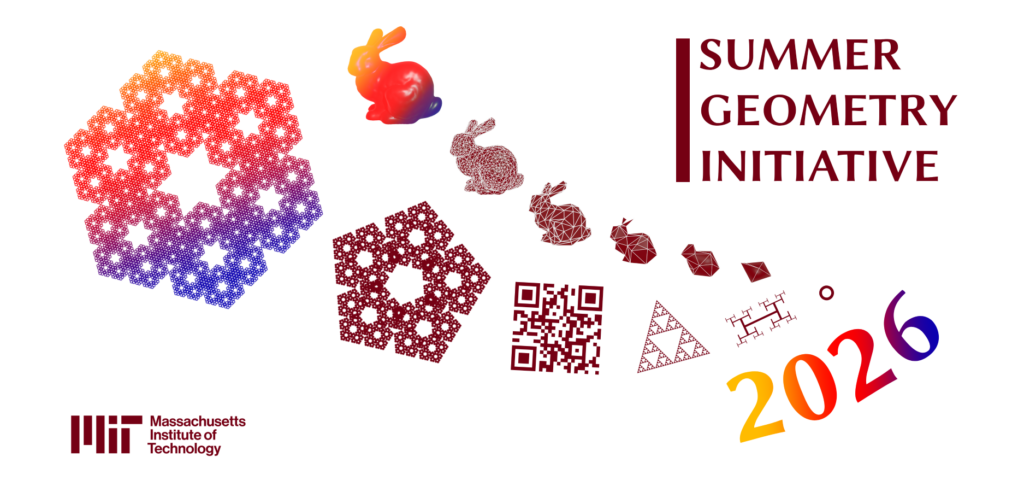
One very nice thing about SGI that I have not seen talked about much: because the first iteration of SGI occurred in 2021, the last digit of the year tells us which iteration we are in! (At least, until 2029.) This year, 2026, corresponds to the 6th cohort, so I set out to use the number 6 as often as possible in my design.
SGI as a program is all about geometry. Now, what kind of geometric patterns we can use that look pretty and can incorporate the number 6? The first thing my mind went to was…
The Fractals
Fractals are self-similar patterns, usually generated from a very concise set of predefined rules. Apart from being very mathematical, I also find them incredibly satisfying to look at. Most readers will likely be familiar with the Sierpinski triangle seen in the fractals sequence. A triangle is scaled down, copied three times, and put at the corners of the original triangle. Then you repeat the process.

But what about the other ones? Turned out, the concept of Sierpinski polygons does actually generalize to any n-gon, and that is what all these shapes are!
So the choice was obvious: I wanted to feature the Sierpinski hexagon in my design. And what does it look like? Well, not as interesting as its triangle counterpart, as it turned out.
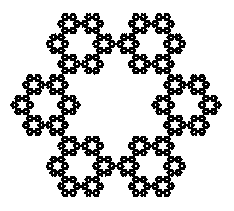
It’s not horrible by any means, but I was hoping to use this as the attention grabber, and this variation had more negative space than I would’ve liked. It also looked too regular for my taste. What I like about fractals is the controlled chaos, how it can look locally chaotic yet attains a striking symmetry as a whole.
Turned out, there was a way to mitigate this: a Sierpinski polygon depends on the scaling factor . In order for the iterated shape to fit together without overlapping, a specific value has to be used, depending on the number of sides. For hexagons, is the “correct” ratio.

What happens when we vary ? We get some pretty interesting results!
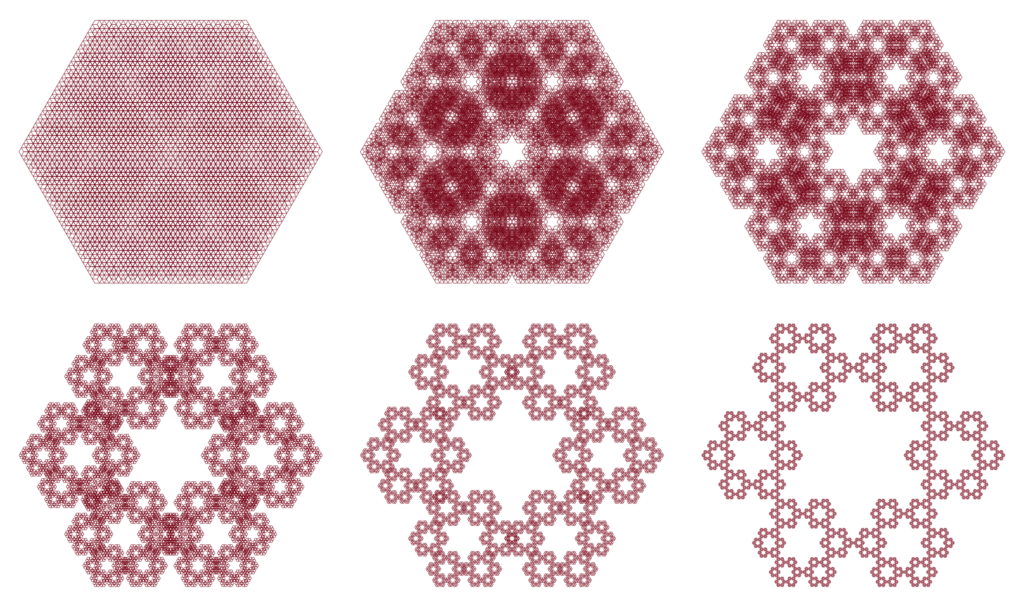
We can also do the same for pentagons, whose “correct” scaling factor is , where is the golden ratio
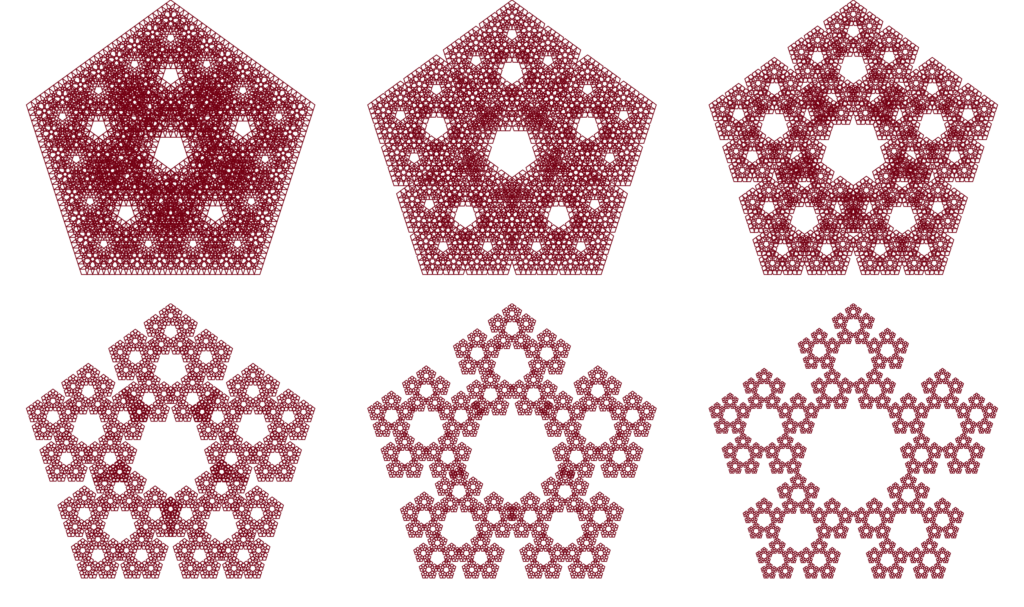
In the end, I just chose an value that looked good. For the hexagon, that turned out to be . I did not realize this at the time, but this was a fairly special value: it was the value that made the corners of the hexagons “touch” at the third iteration. The result: the gaps between hexagons form perfect six-sided stars with sharp points!

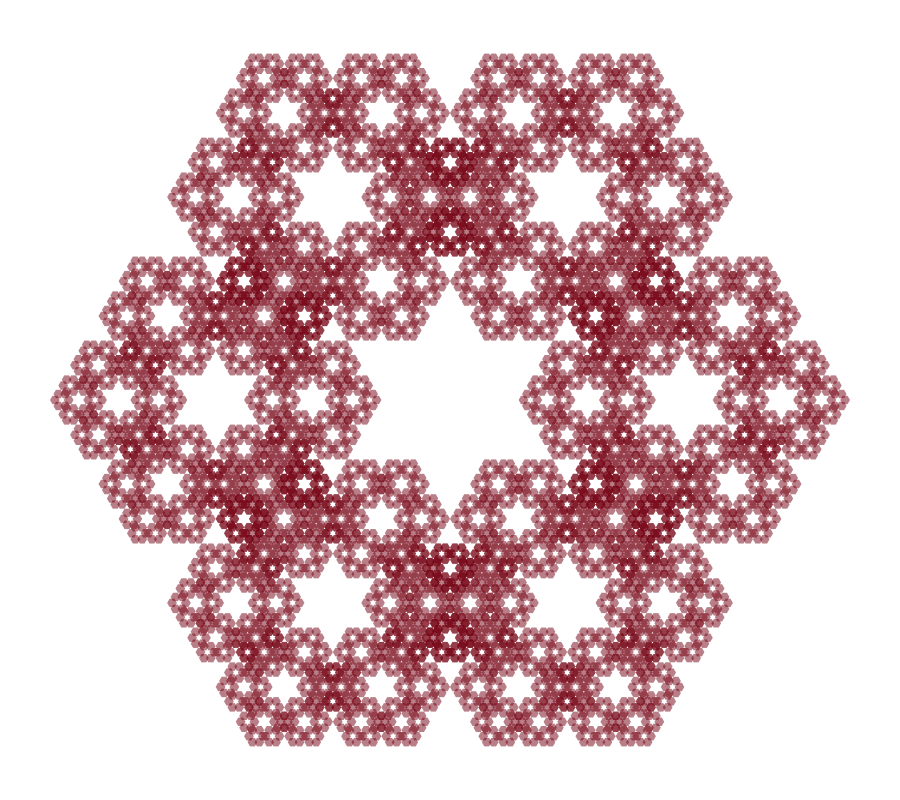
(I didn’t realize this at the time, so the pentagon just used a somewhat random value of . Question for the readers: what would be an equivalent for a pentagon?)
Bonus: the six iterations of the Sierpinski hexagon and pentagon


And yes, I use 6 iterations for all of the fractals, so there’s another hidden number 6 for you ;).
What About the Other Ones?
I wanted to have a sequence of 6 fractals, symbolizing the iterations of SGI itself, which would increase in sophistication and complexity over time. The Sierpinski triangle was simple enough, but how would I make Sierpinski 2-gon and 1-gon? This took some interpretations
- For the 1-gon, I decided to treat it as a point, which has no size. So a Sierpinski-type iteration would just product a point. I visualized this with an empty circle, since you technically can’t draw an infinitesimal point on a 2D canvas.
- I interpreted 2-gon as a line, with the two sides overlapping. Since it also has no area, a Sierpinski 2-gon would also be just a line. To make this more interesting, I decided to create a binary tree instead, which is create from a set of self-similar “I” shapes.
- Sierpinski square was replaced with a QR code leading to the SGI website ;).

Honorable Mentions
I considered a few other fractals to include in the design as well, but ended up going for a simpler design, partially due to time constraint.
Koch’s Snowflake
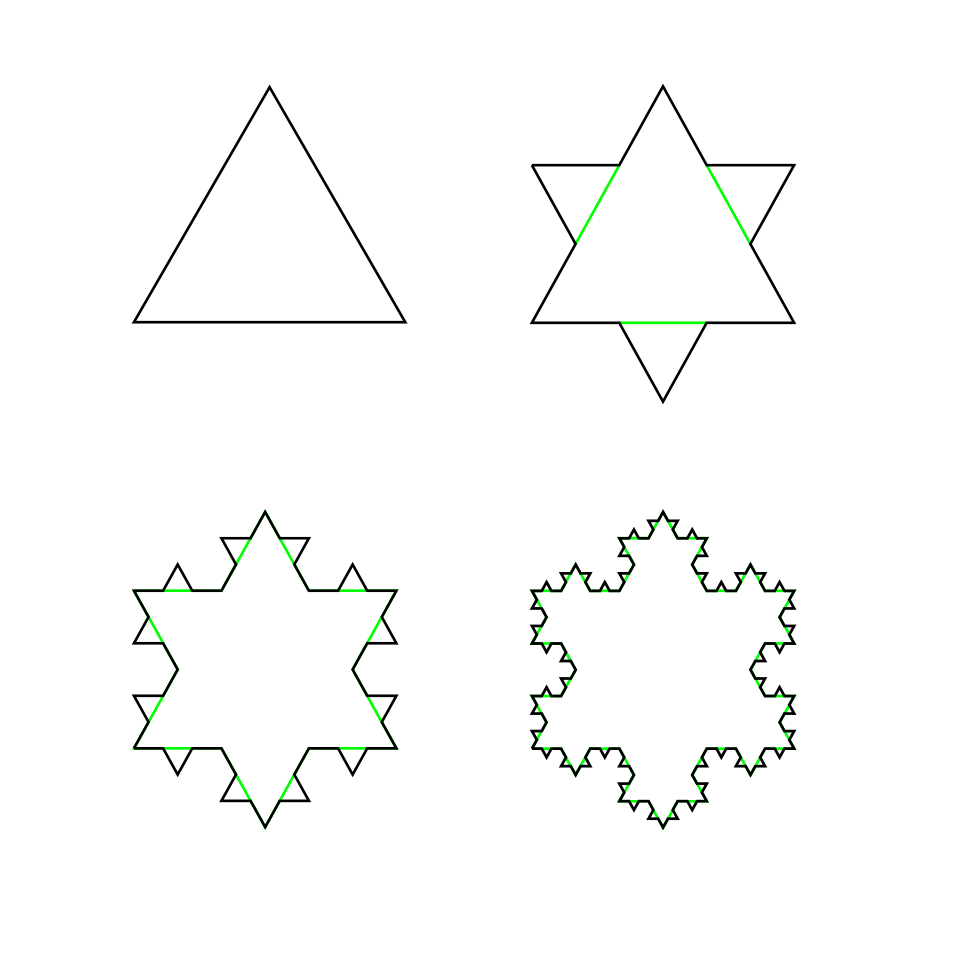
Very iconic, and a natural fit for the number 6. I decided against using it in the end because it was a little too well known, and I wanted a more unique look for our mug.
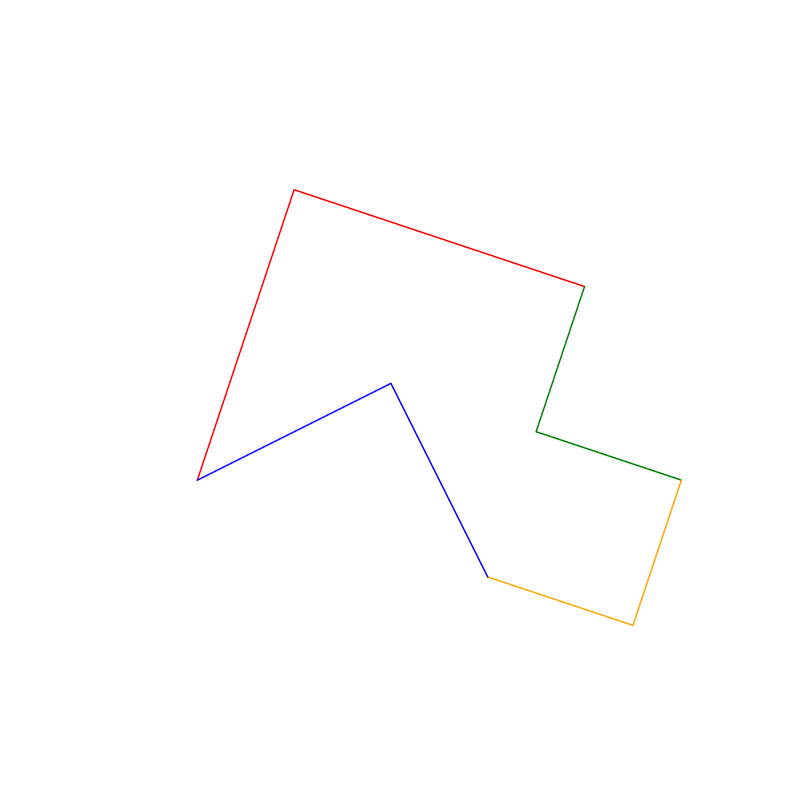
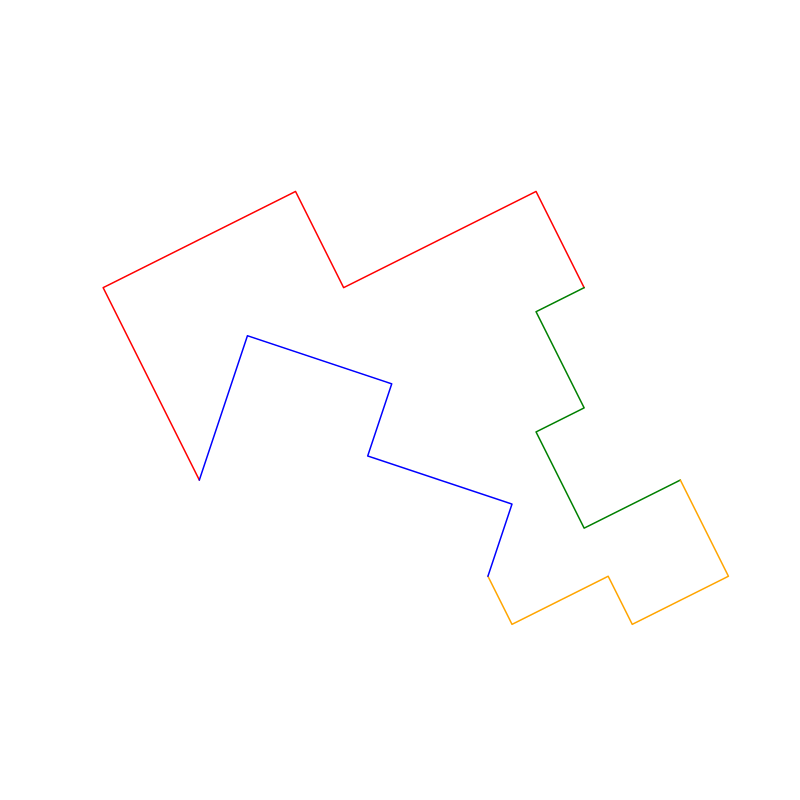
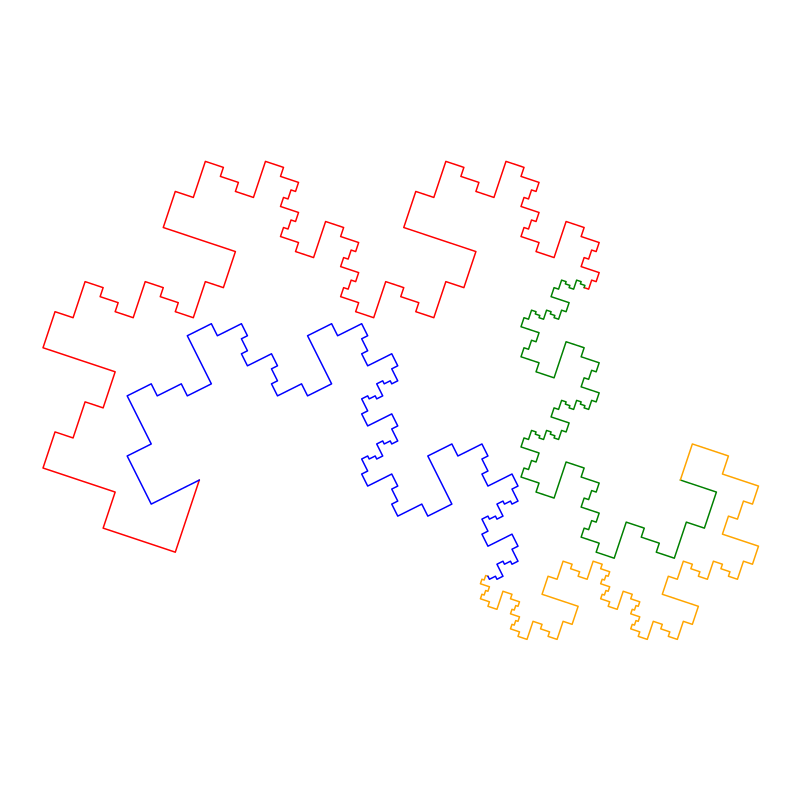
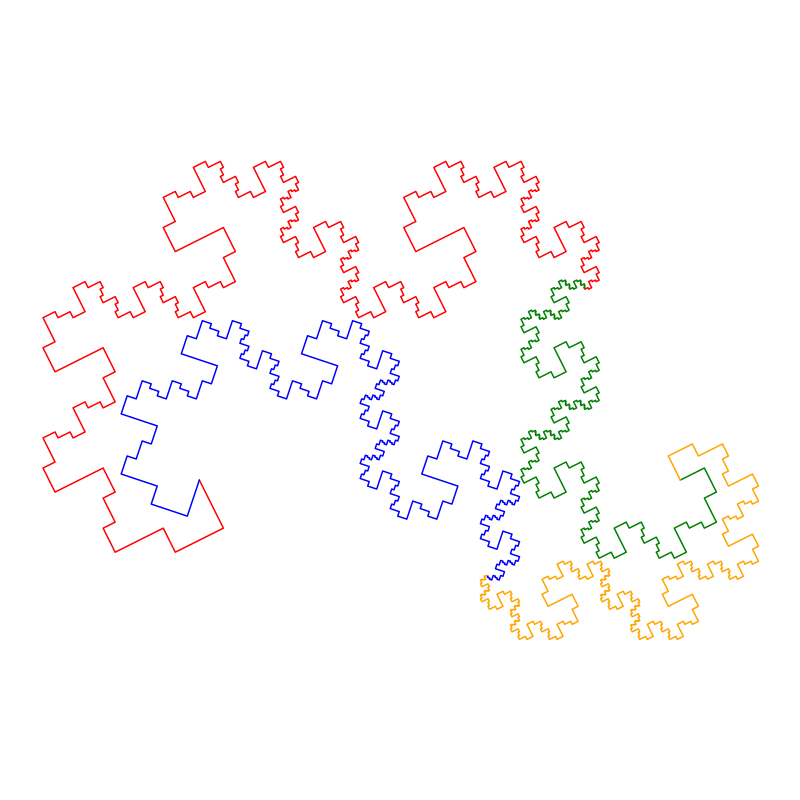
Dragon Curve

Arguably my favorite fractal of all time, especially for its connection to paper folding. Unfortunately, I couldn’t quite figure out how to incorporate it into the design. And there is also a similar issue of negative space: the interesting parts are at the outline, but the interior is plain.


Levy Dragon
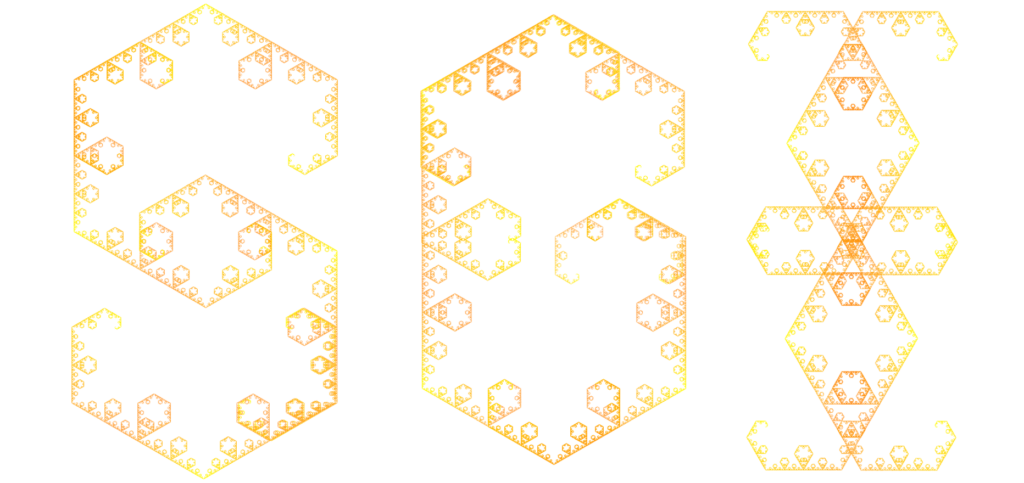
For a while, I really wanted the SGI acronym itself to be a fractal. I ended up playing around the the Levy Dragon, which I arranged into the letters. In the end, I decided it was much too ornate compared to the rest of the design, and did not use it.
Other Mug Designs
There were many other awesome mug designs proposed, most of which served as inspirations for my design!
Gokul S was the first person who proposed a design element in the group chat: a sequence of L-System-based trees. I basically stole the six-fractals-sequence-as-SGI-cohorts from him. I tried really hard to include these trees in my design as well, but unfortunately could not find a good place for them in time :(.

Similarly, Rahim Hossain proposed using levels of decimation of a Stanford Bunny, which I also copied wholesale into my design.
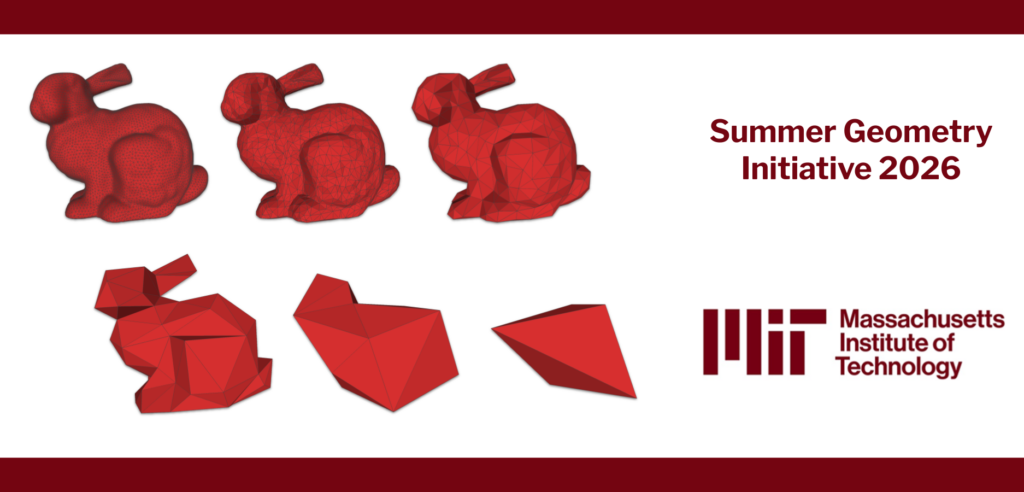
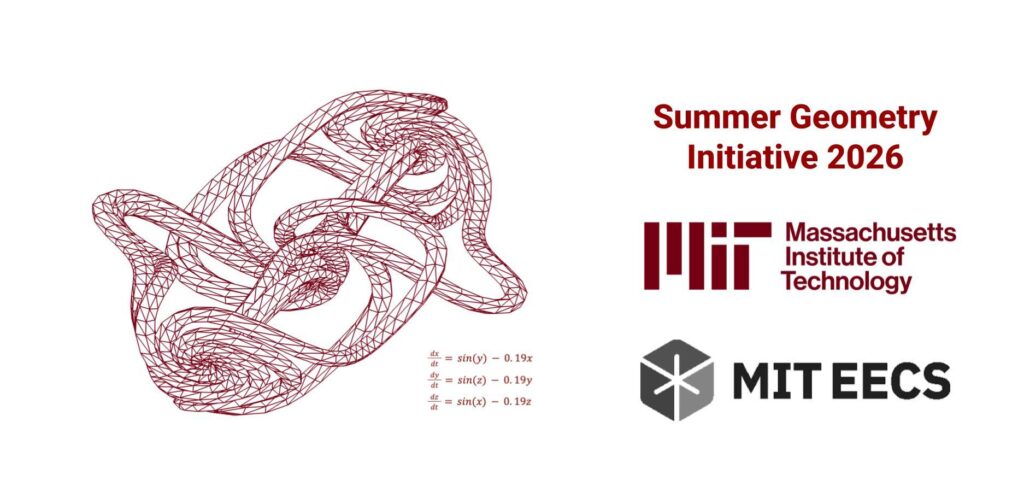
Kyle Loh created this awesome design. In his own words:
[The design] is a continuous-time dynamical system called the Thomas attractor (it is strange and chaotic, by the way).
Finally, Loiruck Godwin proposed a couple of designs, featuring a “grid of bunnies,” and a crystalline cliff that “captures the collaborative nature of SGI, where people of various background’s help each other and work together to climb a geometric mountain of knowledge.”


I would not have been able to push my design as far as I could without these inspirations, and I’m glad I get to at least showcase these designs here, as they deserve to be :).
Final Thoughts
Apparently, a blog post doesn’t feel complete without a concluding section like this, but I also don’t really have a conclusion to offer. So I will just include some tidbits about the design I couldn’t fit elsewhere.
- The first iteration of the design incorporated a giant number 6. My logic was “if you look at this mug on your shelf from a distance, you’d be able to tell it’s the SGI 6 mug right away!” Turned out, everyone unanimously hated the giant 6 😂. Subsequent design iterations featured the year 2026 of a regular size.

- One goal I had for the design was it MUST look good wrapped around a mug. Blender was very useful for visualizing this. I downloaded a 3D mesh of a mug from Sketchfab, and learned to manually unwrap the UV for the first time, which was fun :).