SGI Fellow: Pietro Palombini
Mentor: Ankita Shukla
Project volunteer: João Teixeira
TL;DR. Fel et al. (2026) find that block-sparse featurizers (BSFs) recover continuous concepts in vision models, such as the full circle of curve orientations in InceptionV1. We apply Fel et al.’s tests to sentence embeddings. These tests do not provide clear evidence that blocks recover concept manifolds in the embeddings we studied.
- On text, blocks behave like finer clusters. The coordinates inside a block separate the categories that share it, raising category F1 on DBpedia from 0.54 to 0.79. But k-means clusters do about as well, and a few SAE features selected with labels do better on two of three datasets.
- On synthetic circles, block stable ranks stay between 2.1 and 2.8 as blocks grow. On text they keep rising, so text blocks do not show the fixed low dimension that Fel et al. take as evidence of concepts.
- Blocks give shorter descriptions of text embeddings than SAEs only at a loose reconstruction tolerance. The gain comes from identifying a few blocks instead of many features, and on text the blocks need more bits for everything else.
- Moving a query along block directions retrieves fewer of a target’s neighbors than moving it along the difference between the two neighborhoods’ means.
1. What blocks are supposed to recover
Sparse autoencoders (SAEs) reconstruct activations as sparse combinations of learned directions (Bricken et al., 2023, and Gao et al., 2025). Some concepts vary continuously, such as the orientation of a curve. When a model’s representations of such a concept vary smoothly with it, they trace a concept manifold, which can span several dimensions. Previous work has found circular representations of the days of the week (Engels et al., 2025) and curved representations of character counts (Gurnee et al., 2025) in language models. A single direction cannot reconstruct such variation. BSFs instead reconstruct an embedding from a few active blocks of directions,
$$
\hat x = \sum_{g \in S(x)} D_g z_g,
$$
where \(S(x)\) is the set of active blocks and \(z_g\) are the coordinates of block \(g\). In the BSFs we use, the columns of each \(D_g\) are orthonormal. Our SAE baseline is the same architecture with blocks of size one. BSFs assume that embeddings are sparse sums of points on low-dimensional manifolds (Bhalla et al., 2026, and Fel et al., 2026).
Fel et al. (2026) report the following findings on vision models:
- On synthetic sums of circles and other manifolds, blocks reconstruct the individual manifolds with mean \(R^2\) of 0.93 to 0.97, while the SAE features that best fit each manifold reach about 0.53.
- A block represents the full circle of curve orientations in InceptionV1, which neurons and SAE features divide among separate detectors.
- A block tracks scene luminance in DINOv3.
- Moving within a block steers the images that SDXL, a diffusion model, generates.
- At a fixed reconstruction tolerance, block codes describe DINOv3 activations in fewer bits than SAE codes.
- Fel et al. report mean stable ranks between 2 and 4 even for blocks with 16 coordinates, and interpret this as evidence for concepts with two to four dimensions.
Fel et al. suspect that language fits the BSF assumption poorly, and O’Neill et al. (2024) find no irreducible multi-dimensional structure in the groups of SAE features they inspect on embeddings of arXiv abstracts. In GPT-2, on the other hand, one block of a block-sparse SAE responds to days, months, seasons and years (Dalili & Mahdavi, 2026). Our text datasets provide category labels but no known coordinates along a concept manifold, so we measure what blocks encode with the labels and test Fel et al.’s other evidence on synthetic circles.
2. How blocks organize categories
We use 20 Newsgroups (Lang, 1995), arXiv titles and abstracts (Schopf et al., 2024), and the opening paragraphs of Wikipedia articles with their DBpedia classes (Lehmann et al., 2015), with 19, 113 and 214 topic or entity-type categories. Dictionaries are trained on embeddings from all-mpnet-base-v2, an MPNet model (Song et al., 2020) fine-tuned with the Sentence-Transformers library (Reimers & Gurevych, 2019). We match BSFs and SAEs in both the total number of coordinates and the number active per document. Unless stated otherwise, BSFs have about one block per category, each with three coordinates, and two blocks active per document. Results average five seeds.
For each category, we predict membership from a block’s on/off state or, as Fel et al. do for image classes, from a logistic classifier on its coordinates. We compare blocks with untrained random blocks, with k-means clusters read out through three principal components each, and with single SAE features or groups of up to three. The clusters show what a partition of the space achieves without a dictionary. For every method, labels from training documents choose which unit reads out each category. For SAE groups, the labels also choose which features to combine, whereas BSF training groups directions without labels, so these groups test whether a few features chosen with labels can match a block learned without them. We evaluate all methods on test documents held out from training.
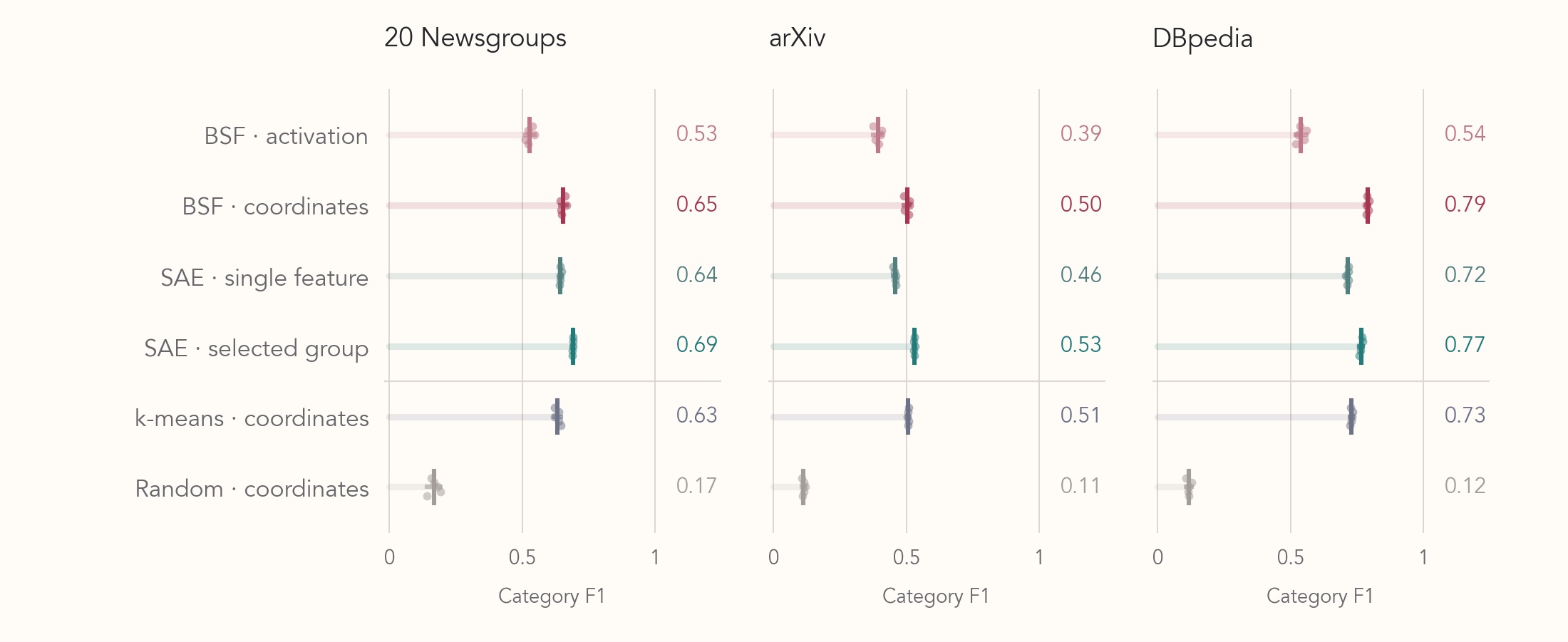
Reading a block’s coordinates instead of its on/off state raises F1 on all three datasets, most on DBpedia, from 0.54 to 0.79 (Figure 1). Block coordinates match a single SAE feature on 20 Newsgroups and exceed it on the other two datasets. Selected SAE groups score highest on 20 Newsgroups and arXiv. k-means clusters come within 0.06 of block coordinates on all three datasets.
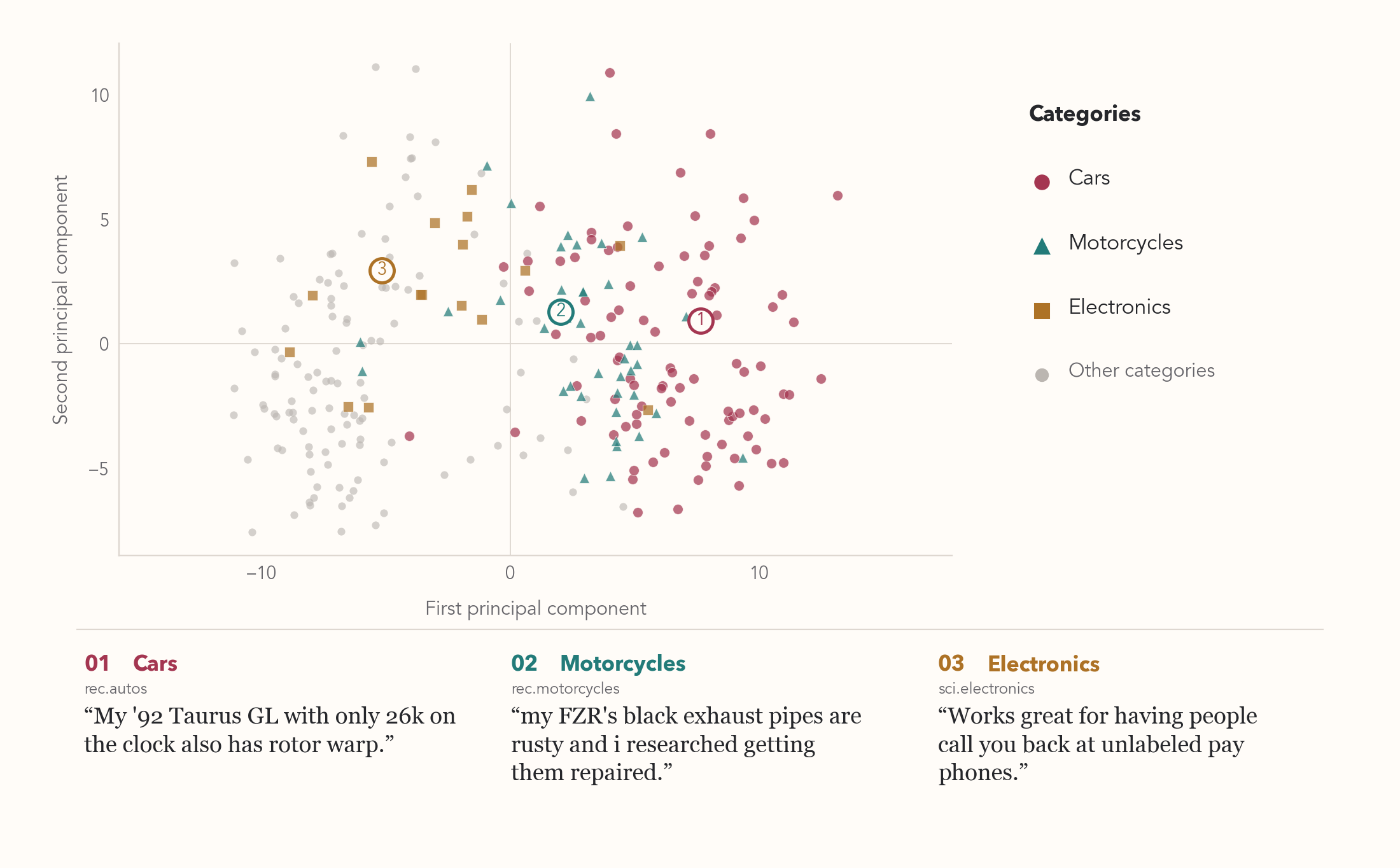
A block active for several categories is a poor on/off detector for each of them, even when its coordinates separate them. The block in Figure 2 is active for posts about cars, motorcycles, electronics and other topics. Along the first principal component of its coordinates, car posts lie on one side and electronics posts on the other, with motorcycle posts between them.
Dictionaries with more blocks give detectors with higher precision and lower recall (Table 1). This is consistent with each category being divided among several blocks, as in feature splitting in SAEs (Bricken et al., 2023, Chanin et al., 2025, and Leask et al., 2025). We test this by pooling the eight detectors with the highest training F1 for each category and predicting the category when any of them is active.
Table 1. On/off detection on 20 Newsgroups as the number of blocks grows.
| Blocks | Blocks per category | Precision | Recall | F1 |
|---|---|---|---|---|
| 24 | 1.3 | 0.43 | 0.70 | 0.53 |
| 256 | 13 | 0.80 | 0.23 | 0.35 |
| 512 | 27 | 0.83 | 0.15 | 0.25 |
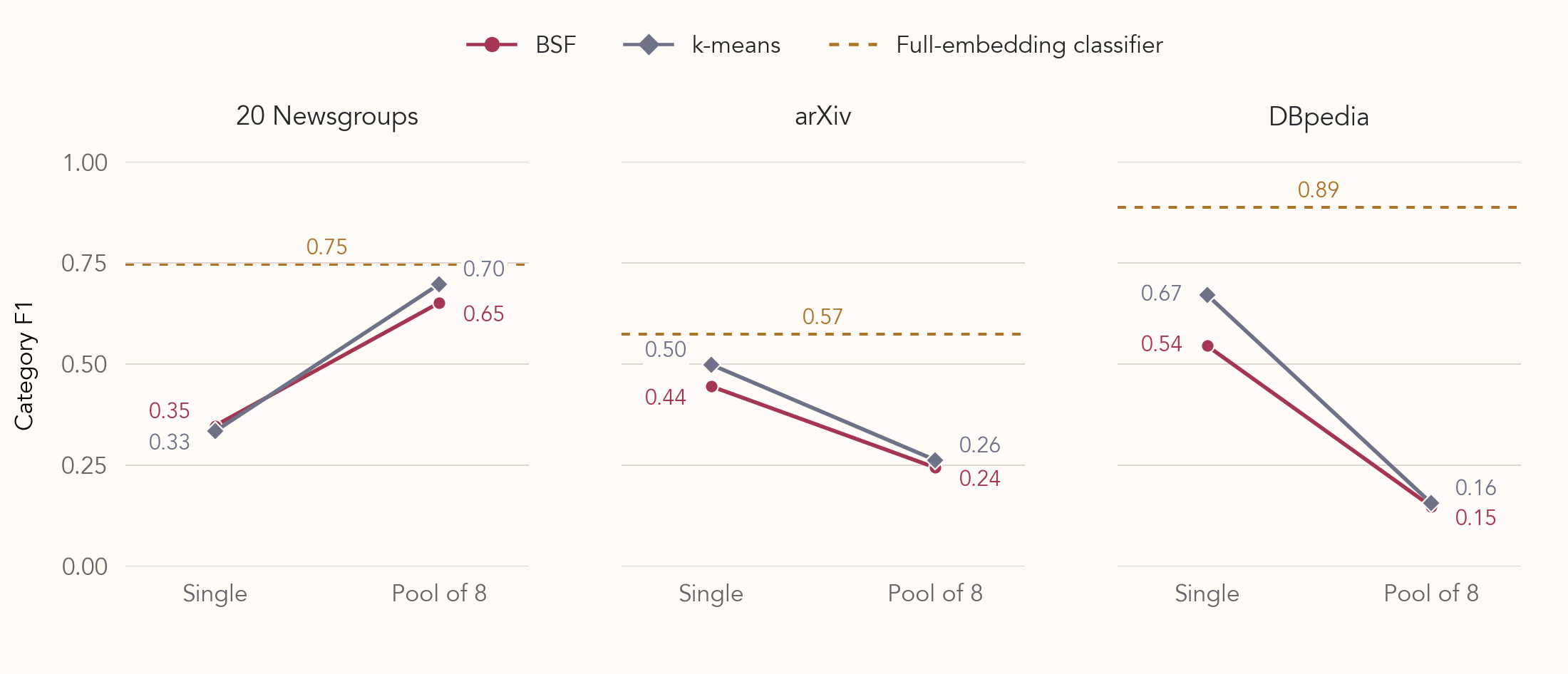
Pooling raises F1 on 20 Newsgroups from 0.35 to 0.65, against 0.75 for the full-embedding classifier, but lowers it on arXiv and DBpedia (Figure 3). With 256 units, 20 Newsgroups has about 13 units per category, arXiv 2 and DBpedia 1. Pooled clusters match or exceed pooled blocks on all three datasets.
3. Where category information lies in the embeddings
k-means comes close to blocks without training a dictionary, so we measure how much category information lies in the category means and in the variation around them. Let \(\mu_c\) be the mean of normalized training embeddings in category \(c\), and \(\bar\mu\) the mean of those centroids. Their centered span is the centroid subspace, which contains each category’s difference-in-means direction:
$$
S_{\mathrm{centroid}}
= \mathrm{span}\{\mu_c-\bar\mu\}_{c=1}^{C},
\qquad
\dim S_{\mathrm{centroid}}\le C-1,
$$ where \(C\) is the number of categories.
MPNet, MiniLM (Wang et al., 2020), E5 (Wang et al., 2022) and BGE (Xiao et al., 2024) show similar relative arrangements of category means. For each pair of models, we correlate the cosine similarities between centered category means, and the correlations range from 0.915 to 0.995 across the three datasets (Figure 4).
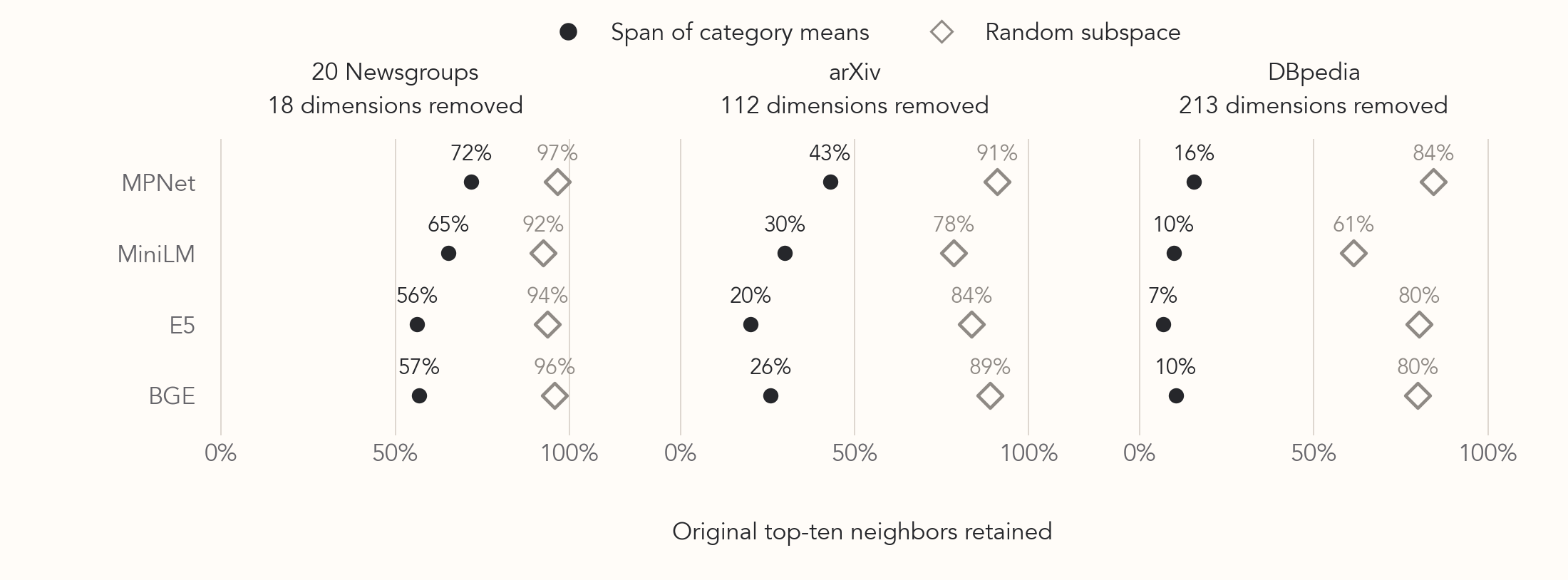
Projecting out the centroid subspace removes far more of each test query’s nearest neighbors than projecting out a random subspace of the same dimension (Figure 5). With MPNet, 72% of the neighbors remain on 20 Newsgroups and 16% on DBpedia, against 97% and 84% for the random subspace. The gap grows with the number of categories.
The variation around the means is also specific to each category. After removing the centroid subspace from MPNet embeddings of 20 Newsgroups, 20 principal components fit to a category explain 36% of the variance of its test documents around the category mean. Components fit to all training documents explain 20%, those of another category 11%, and random directions 3%. A clustering with local coordinates can use both kinds of information.
4. Recovering known circles
Separating categories does not show that a block reconstructs the variation within a concept, as the orientation block of Fel et al. does. We test this on synthetic data with known manifolds, as in the toy tests of Bhalla et al. (2026) and Fel et al. (2026). Twenty circles lie in random planes of a 768-dimensional space, and each sample sums one point from each of three random circles, with or without isotropic noise of standard deviation 0.05 per coordinate. We assign each circle a block, a single SAE feature and a group of up to three SAE features by their reconstruction of it on training samples. On independently generated test samples, reconstruction \(R^2\) measures how much of the circle’s contribution the unit reconstructs, and presence F1 measures whether the unit is active exactly when the circle is present. Untrained random blocks give a chance baseline. As a reference, we also reconstruct each circle from its known plane and the identities of the contributing circles.
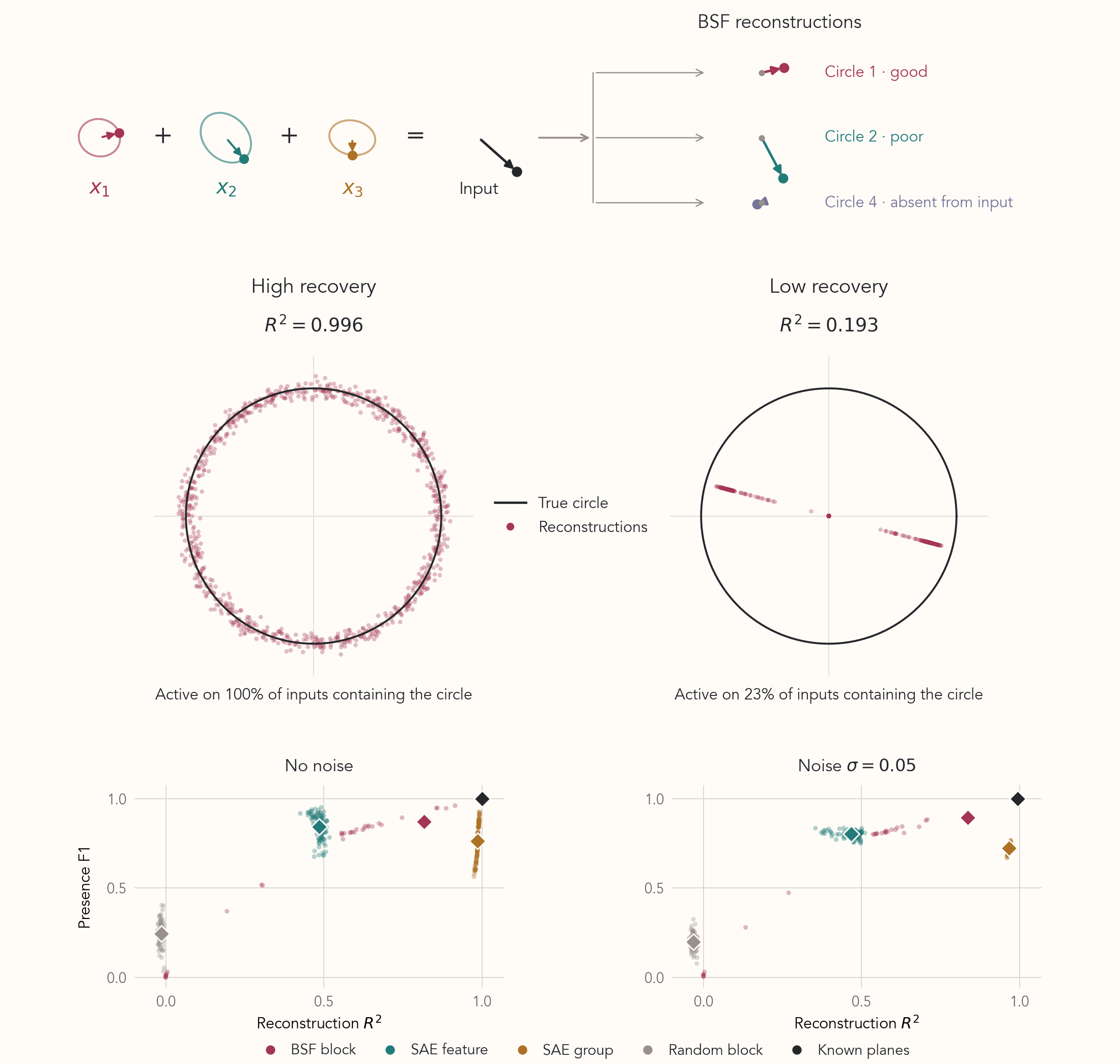
Without noise, 66 of 100 assigned blocks reconstruct their circle with \(R^2\) above 0.95. The others vary widely, from almost nothing to about 0.9, and the low-recovery block in Figure 6 outputs points near a line through its circle. Blocks therefore reach a mean reconstruction \(R^2\) of 0.82, compared with 0.48 for a single SAE feature, about what one direction can capture, and 0.99 for an SAE group (Figure 6). Blocks detect their circles more reliably than SAE groups, with presence F1 of 0.87 against 0.76. With noise, blocks still achieve lower reconstruction \(R^2\) but higher presence F1 than SAE groups. Scored as in Fel et al.’s toy test, which matches blocks to circles by when they are active and computes \(R^2\) only on inputs that contain the circle, blocks average 0.90 without noise and the best pair of SAE features 0.95. Fel et al. report 0.93 to 0.97 for blocks and 0.53 for a TopK SAE, in a denser setting of 128 manifolds of eight types in 128 dimensions.
Fel et al. interpret mean stable ranks between 2 and 4 as evidence for concepts with two to four dimensions. Table 2 compares text with the noisy circles, whose linear spans have dimension two, at matched numbers of total and active coordinates. We compute stable rank after centering each block’s codes over the inputs where it is active.
Table 2. Mean stable rank of centered block codes on test data, with 768 total and 48 active coordinates. Random blocks are untrained.
| Block size | 20 Newsgroups | arXiv | DBpedia | Random blocks (20 Newsgroups) | Circles |
|---|---|---|---|---|---|
| 3 | 2.1 | 2.0 | 2.0 | 2.2 | 2.4 |
| 4 | 2.4 | 2.4 | 2.4 | 2.7 | 2.8 |
| 8 | 3.5 | 3.3 | 3.1 | 4.2 | 2.8 |
| 16 | 4.8 | 4.7 | 4.3 | 6.2 | 2.1 |
Blocks fit to the circles stay between 2.1 and 2.8 as blocks grow, ending at 2.1 at size sixteen (Table 2). The value does not determine a concept’s dimension exactly, but for the circles it stays within a narrow band. Text stable ranks instead rise steadily with block size, from about 2 at size three to between 4.3 and 4.8 at size sixteen, between the circles and untrained random blocks. Text blocks therefore do not show the fixed low dimension that Fel et al. take as evidence of concepts.
5. Description length
Fel et al. compare the bits needed to describe DINOv3 activations at a fixed reconstruction tolerance. We use a simpler estimate than Fel et al.’s. Following Ayonrinde et al. (2024), each active coefficient takes a fixed number of bits and we leave out the dictionary, and our residual term assumes isotropic Gaussian noise where Fel et al. use the residual’s covariance. With \(G\) blocks of size \(b\), \(k\) of them active, and coefficients quantized to \(B\) bits,
$$
L =
\mathop{\log_2{G \choose k}}\limits_{\mathrm{which\ blocks\ are\ active}}
+ \mathop{kbB}\limits_{\mathrm{their\ coefficients}}
+ \mathop{L_{\mathrm{residual}}}\limits_{\mathrm{remaining\ reconstruction\ error}}.
$$
Grouping shortens the index, the term Fel et al. single out as what distinguishes block codes from SAE codes. Identifying 12 active SAE features among 768 takes 86 bits, and identifying 4 active blocks among 256 takes 27.
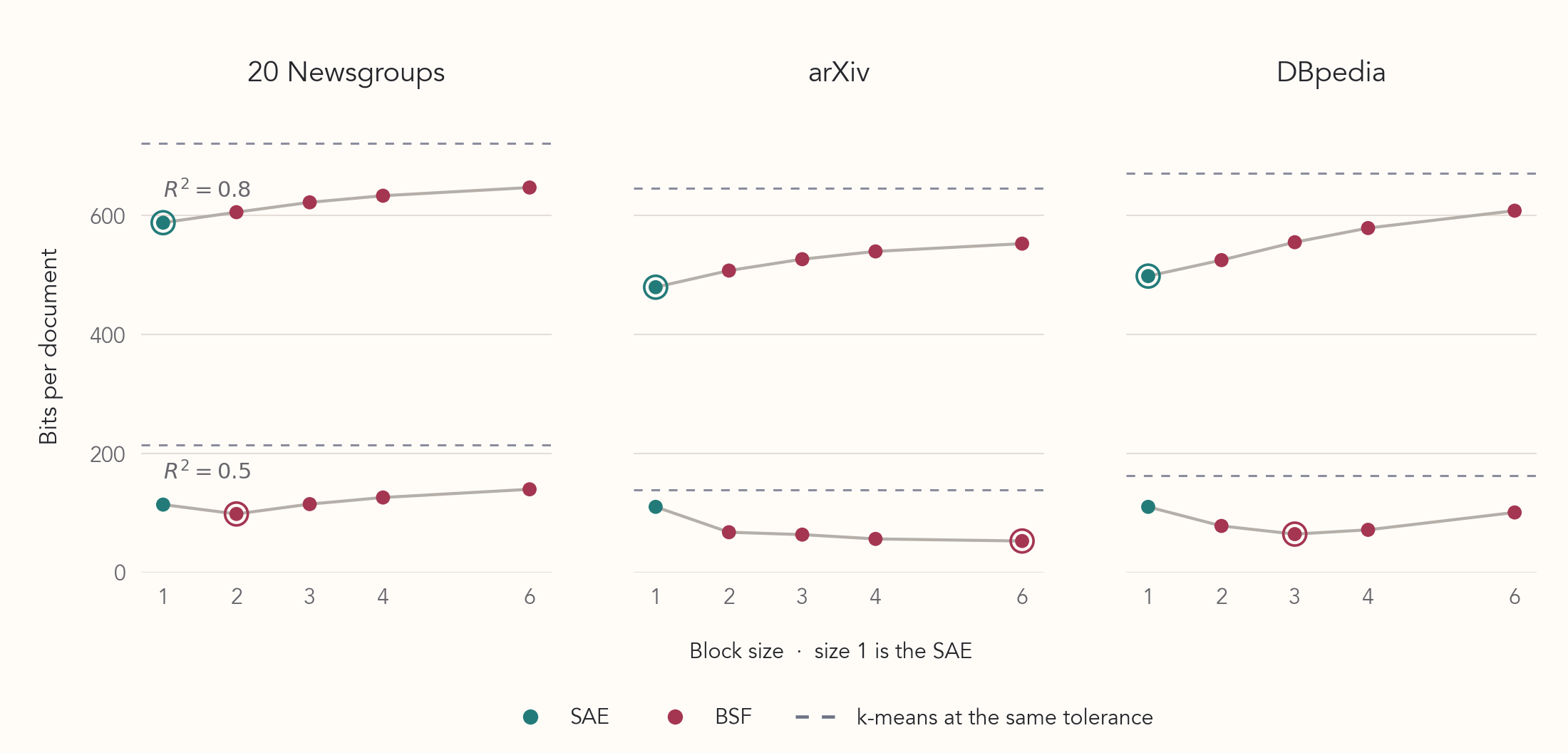
At \(R^2=0.5\), some block sizes give shorter descriptions than the SAE on every dataset, and all do on arXiv and DBpedia (Figure 7). At \(R^2=0.8\), where coefficients and residual make up most of the length, the SAE is shortest on all three datasets. Each advantage of blocks is smaller than their reduction in index bits, so blocks take more bits than the SAE for coefficients and residual, and their shorter descriptions come from the index alone. With the same number of coordinates, blocks also achieve lower test \(R^2\), from 0.55 for the SAE to 0.43 for blocks of six on 20 Newsgroups.
6. Retrieval interventions
Fel et al. change generated images by moving activations within blocks. For text, we move a query toward a target document and measure how many of the target’s ten nearest neighbors the moved query retrieves, taking the best step size. Directions come from single units, full codes, pooled block or cluster spans, or the difference between the means of the target’s and the source’s neighborhoods (Marks & Tegmark, 2024). Apart from a random baseline and interpolation toward the target itself, all directions are built from the target’s neighbors, so the test measures how well each representation expresses a known displacement.
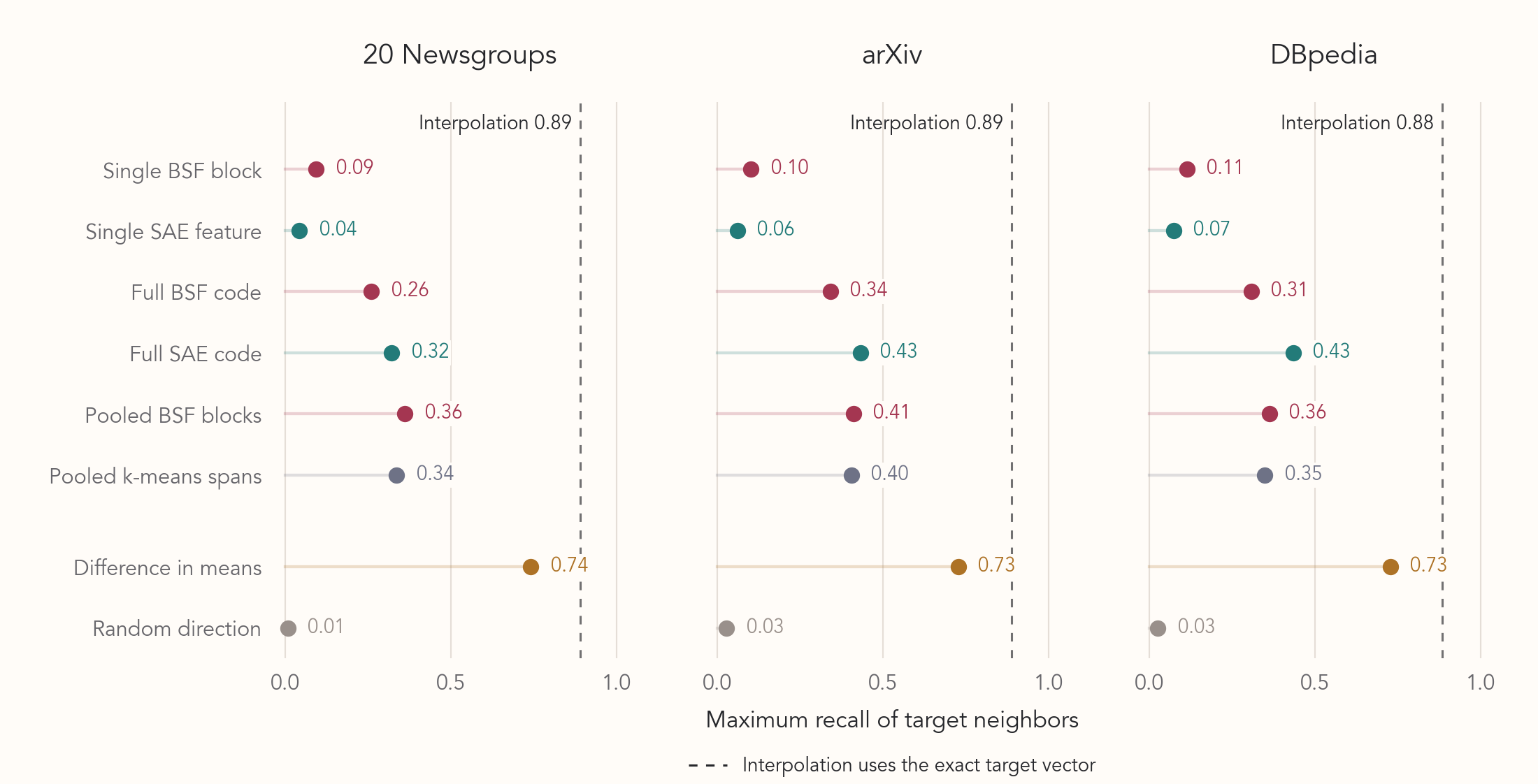
The difference between neighborhood means recovers 0.73 to 0.74 of the target’s neighbors, against at most 0.43 for any dictionary or cluster direction (Figure 8). Wu et al. (2025) likewise find difference-in-means directions ahead of SAE features for detecting and steering concepts in Gemma 2. A single block outperforms a single SAE feature, but the full SAE code outperforms the full BSF code on all three datasets, and pooled k-means spans come within 0.03 of pooled blocks. These dictionaries were trained only for reconstruction, unlike the SAEs of Kang et al. (2025), which are trained with a retrieval objective.
7. Key takeaways
- Compare blocks with k-means clusters and with small groups of SAE features chosen with labels before interpreting a block as a concept manifold. On text, clusters with local coordinates separated categories nearly as well as block coordinates, and the SAE groups did better on two of the three datasets.
- Measure stable rank at several block sizes, and on synthetic data of known dimension, before reading it as a concept’s dimension. A single value did not reveal the dimension even for noisy circles. The trend separated text from circles, since text ranks kept rising with block size and circle ranks did not.
- Compare description lengths at the same tolerance, and split each length into its terms. On text, blocks gave shorter descriptions only at a loose tolerance, and only because their index was shorter.
- Use the difference between neighborhood means as a baseline for this kind of retrieval intervention. It retrieved more of a target’s neighbors than any dictionary or cluster direction we tested.
8. Conclusion
In our experiments on sentence embeddings, blocks behave like clusters with local coordinates, and Fel et al.’s tests do not provide clear evidence that they recover concept manifolds. A useful next step is to evaluate text with controlled variation within a concept and test whether block coordinates track that variation. Our dictionaries also train on up to about 40,000 documents per dataset, far fewer than the billions of token activations used for language-model SAEs (Gao et al., 2025, and Lieberum et al., 2024), so larger training sets could change these results.
References
- Ayonrinde, K., Pearce, M. T., & Sharkey, L. (2024). Interpretability as Compression: Reconsidering SAE Explanations of Neural Activations with MDL-SAEs. NeurIPS 2024 Workshop on Machine Learning and Compression. arXiv:2410.11179
- Bhalla, U., Fel, T., Rager, C., Feucht, S., Haklay, T., Wurgaft, D., Boppana, S., Kowal, M., Shyam, V., Merullo, J., Geiger, A., & Lubana, E. S. (2026). Do Sparse Autoencoders Capture Concept Manifolds? arXiv:2604.28119
- Bricken, T., Templeton, A., Batson, J., et al. (2023). Towards Monosemanticity: Decomposing Language Models With Dictionary Learning. Transformer Circuits Thread. link
- Chanin, D., Wilken-Smith, J., Dulka, T., Bhatnagar, H., Golechha, S., & Bloom, J. (2025). A is for Absorption: Studying Feature Splitting and Absorption in Sparse Autoencoders. NeurIPS 2025. arXiv:2409.14507
- Dalili, S. A., & Mahdavi, M. (2026). Subspace-Aware Sparse Autoencoders for Effective Mechanistic Interpretability. arXiv:2606.06333
- Engels, J., Michaud, E. J., Liao, I., Gurnee, W., & Tegmark, M. (2025). Not All Language Model Features Are One-Dimensionally Linear. ICLR 2025. arXiv:2405.14860
- Fel, T., Kowal, M., Jacobs, M., et al. (2026). Structuring Sparsity: Block-Sparse Featurizers Capture Visual Concept Manifolds. arXiv:2606.25234
- Gao, L., Dupré la Tour, T., Tillman, H., Goh, G., Troll, R., Radford, A., Sutskever, I., Leike, J., & Wu, J. (2025). Scaling and evaluating sparse autoencoders. ICLR 2025. arXiv:2406.04093
- Gurnee, W., Ameisen, E., Kauvar, I., Tarng, J., Pearce, A., Olah, C., & Batson, J. (2025). When Models Manipulate Manifolds: The Geometry of a Counting Task. Transformer Circuits Thread. link
- Kang, H., Wang, T., & Xiong, C. (2025). Interpret and Control Dense Retrieval with Sparse Latent Features. NAACL 2025. link
- Lang, K. (1995). NewsWeeder: Learning to Filter Netnews. Proceedings of the Twelfth International Conference on Machine Learning, 331-339. link
- Leask, P., Bussmann, B., Pearce, M., Bloom, J., Tigges, C., Al Moubayed, N., Sharkey, L., & Nanda, N. (2025). Sparse Autoencoders Do Not Find Canonical Units of Analysis. ICLR 2025. arXiv:2502.04878
- Lehmann, J., Isele, R., Jakob, M., Jentzsch, A., Kontokostas, D., Mendes, P. N., Hellmann, S., Morsey, M., van Kleef, P., Auer, S., & Bizer, C. (2015). DBpedia: A large-scale, multilingual knowledge base extracted from Wikipedia. Semantic Web, 6(2), 167-195. doi:10.3233/SW-140134
- Lieberum, T., Rajamanoharan, S., Conmy, A., Smith, L., Sonnerat, N., Varma, V., Kramár, J., Dragan, A., Shah, R., & Nanda, N. (2024). Gemma Scope: Open Sparse Autoencoders Everywhere All At Once on Gemma 2. Proceedings of the 7th BlackboxNLP Workshop, 278-300. arXiv:2408.05147
- Marks, S., & Tegmark, M. (2024). The Geometry of Truth: Emergent Linear Structure in Large Language Model Representations of True/False Datasets. COLM 2024. arXiv:2310.06824
- O’Neill, C., Ye, C., Iyer, K., & Wu, J. F. (2024). Disentangling Dense Embeddings with Sparse Autoencoders. arXiv:2408.00657
- Reimers, N., & Gurevych, I. (2019). Sentence-BERT: Sentence Embeddings using Siamese BERT-Networks. EMNLP-IJCNLP 2019. arXiv:1908.10084
- Schopf, T., Blatzheim, A., Machner, N., & Matthes, F. (2024). Efficient Few-shot Learning for Multi-label Classification of Scientific Documents with Many Classes. ICNLSP 2024, 186-198. link
- Song, K., Tan, X., Qin, T., Lu, J., & Liu, T.-Y. (2020). MPNet: Masked and Permuted Pre-training for Language Understanding. NeurIPS 2020. arXiv:2004.09297
- Wang, L., Yang, N., Huang, X., Jiao, B., Yang, L., Jiang, D., Majumder, R., & Wei, F. (2022). Text Embeddings by Weakly-Supervised Contrastive Pre-training. arXiv:2212.03533
- Wang, W., Wei, F., Dong, L., Bao, H., Yang, N., & Zhou, M. (2020). MiniLM: Deep Self-Attention Distillation for Task-Agnostic Compression of Pre-Trained Transformers. NeurIPS 2020. arXiv:2002.10957
- Wu, Z., Arora, A., Geiger, A., Wang, Z., Huang, J., Jurafsky, D., Manning, C. D., & Potts, C. (2025). AxBench: Steering LLMs? Even Simple Baselines Outperform Sparse Autoencoders. ICML 2025. arXiv:2501.17148
- Xiao, S., Liu, Z., Zhang, P., Muennighoff, N., Lian, D., & Nie, J.-Y. (2024). C-Pack: Packed Resources For General Chinese Embeddings. SIGIR 2024. arXiv:2309.07597