Hello! My name is Nafisa Nawrin Labonno, and I am an undergraduate student at the University of Texas at Arlington, studying Physics and Computer Science. In this blog post, I will walk you all through my journey as an SGI 2026 Fellow.
To a beginner, everything feels exciting and overwhelming. But to a curious beginner, things feel challenging enough to channel their inquisitiveness into something meaningful. I would say this is my experience with my fellowship at SGI. From the tutorials week to my first week of mentored research here at SGI, I had an amazing time dipping my toe into the shallow waters of Geometry, which is eventually (and hopefully) taking a deep dive into wonderful research.
Geometry is a branch of Mathematics that studies properties of space such as shape, size, distance, and relative position of objects.
Geometry processing is a subfield of Computer Graphics (more generally, Computer Science and Engineering) and Applied Mathematics that develops algorithms to analyze, reconstruct, edit, and simulate 3D shapes
Essentially, geometry processing is the field that sits between “a shape exists” and “a computer can do something useful with that shape.”
Think of a 3D mesh as a mountain scanned by a drone, a character in a game, a protein structure, or your own face captured by a phone camera. To a computer, that’s just a giant list of triangles: vertices, edges, faces. No inherent sense of “smooth,” “curved,” “similar to this other shape,” or “this is the front.”
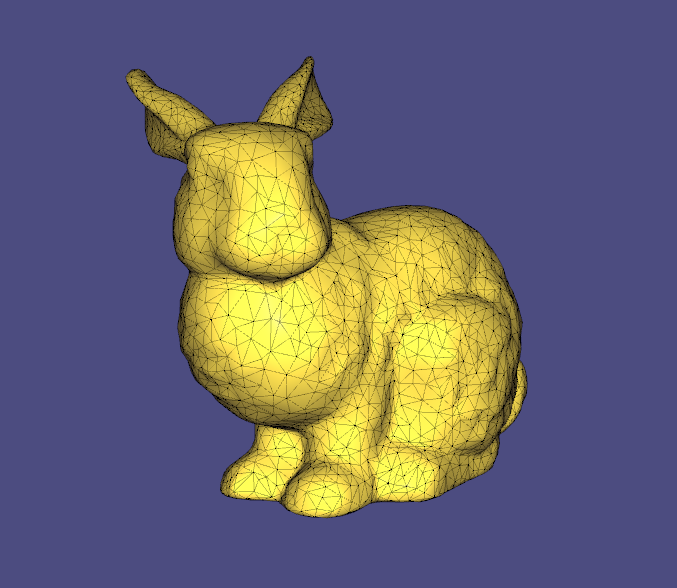
Geometry processing is the toolkit that puts that sense back in. It asks questions like:
- How curved is this surface, at this specific point, and how do we even define “curved” without calculus breaking on a sharp mesh edge?
- If I deform this shape, what stays invariant?
- Can I describe this shape as “a point in a space of shapes” so that “similar shapes” means “nearby points”?
and so on.
Process Overview
At first glance, geometry processing may seem like just another area of computer graphics. In reality, it draws ideas from differential geometry, linear algebra, numerical analysis, optimization, and computer science. Throughout SGI Tutorials Week, Fellows explored this interdisciplinary field from several complementary perspectives, each highlighting a different way of thinking about the same geometric object.
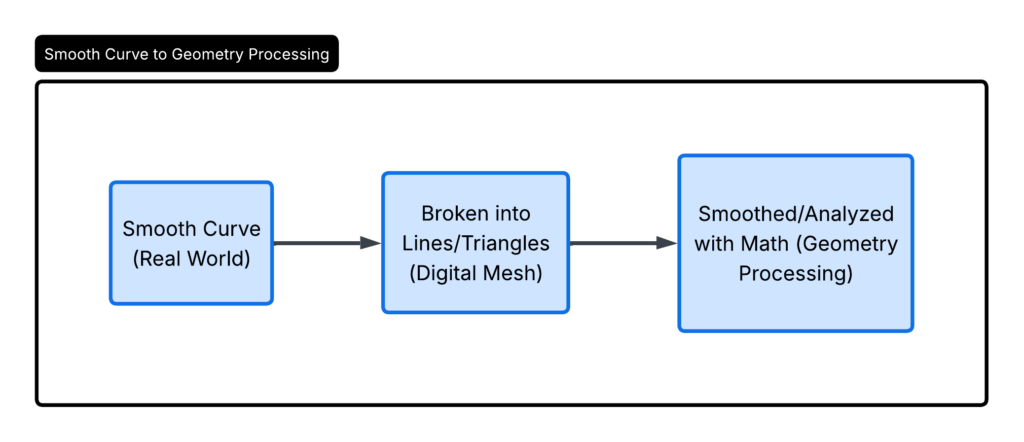
Now, why is this perspective important?
Earlier during the Tutorials Week, we were introduced to the field of Geometry and Geometry Processing from four different perspectives.
To the
- Layman – A figurative shape may hold some value but not necessarily insight.
- Mathematician – The same shape gives rise to a plethora of questions followed by a paramount of insight. The Mathematician defines the shape as a smooth manifold, which is a surface that locally looks like flat Euclidean space, allowing us to measure lengths, angles, and areas on it. The main challenge lies in approximating smooth geometry using triangles. Gaussian curvature K is defined from the shape operator (equivalently, the product of the principal curvatures). A remarkable result, the Gauss–Bonnet theorem, connects the total curvature of a surface to its topology (for a closed surface):
where is the Euler characteristic (a single number that measures the global topology and “hole structure” of a 3D object or 2D surface). - Programmer – While the Mathematician views the pristine manifold with rigor and perfection, the Programmer’s world demands that it be represented as a discrete mesh. This means the “manifold” from the mathematician’s world has to be discretized, and every discrete operator is an approximation whose convergence to the smooth operator must be justified as the mesh is refined. One common discrete analogue of Gaussian curvature is the angle defect at a vertex v:
where are the interior angles of the triangles meeting at v.
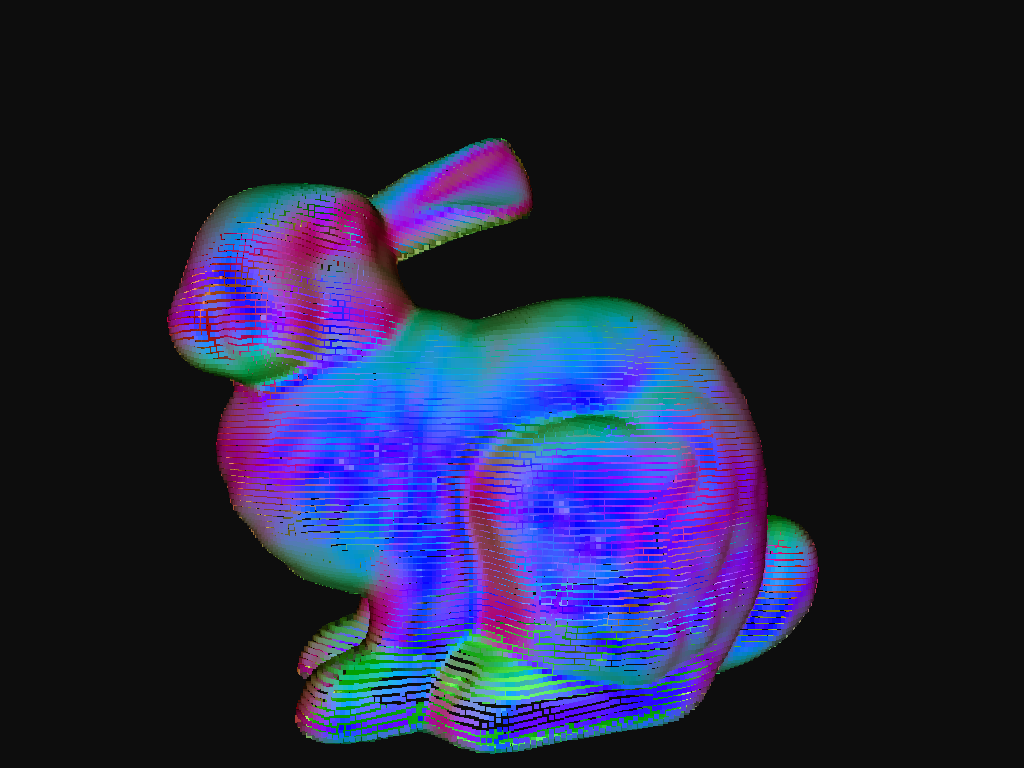
Flat vertex (angles sum to ) means zero curvature. A cone-like vertex results in nonzero curvature. Behind the scenes, it’s all discrete mathematics bonding with mathematical theorems, which gives rise to some wonders to be discussed in the Artist’s section. - Artist – The Artist’s lens allows them to spot any phenomenon, in the absence of rigorous Mathematics or heavy computation, to give insights that are meaningful regardless of your background. The Artist appreciates what the scientifically grounded eye misses. To illustrate this perspective, I rendered several visualizations of the Stanford Bunny using Open3D.
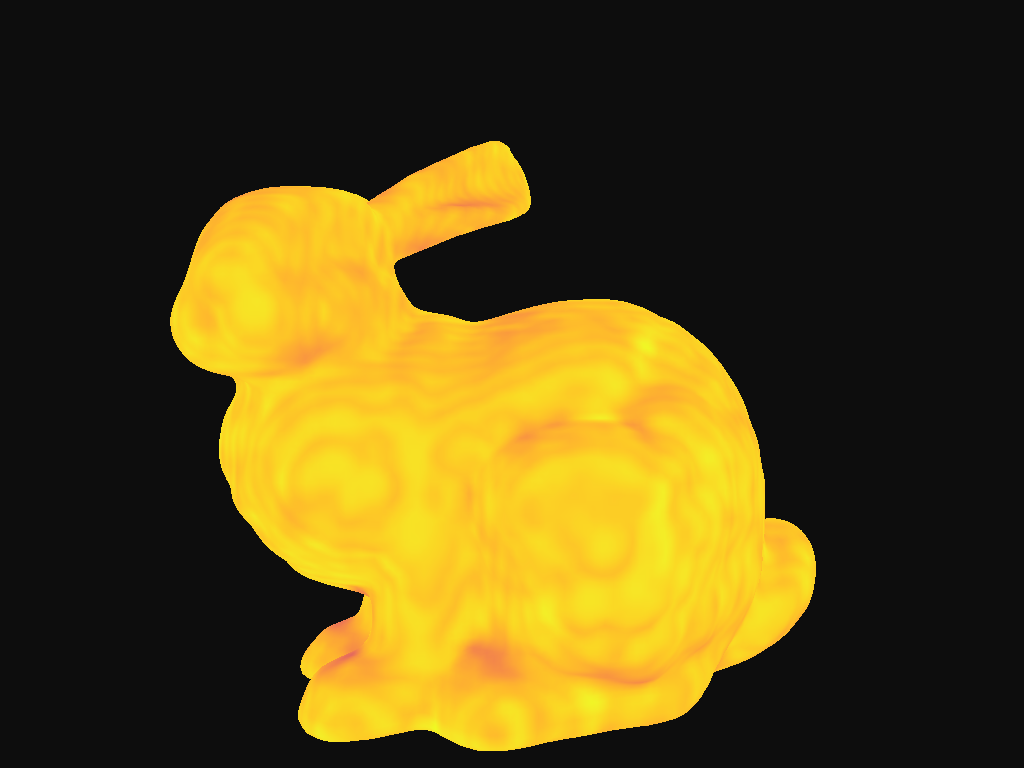
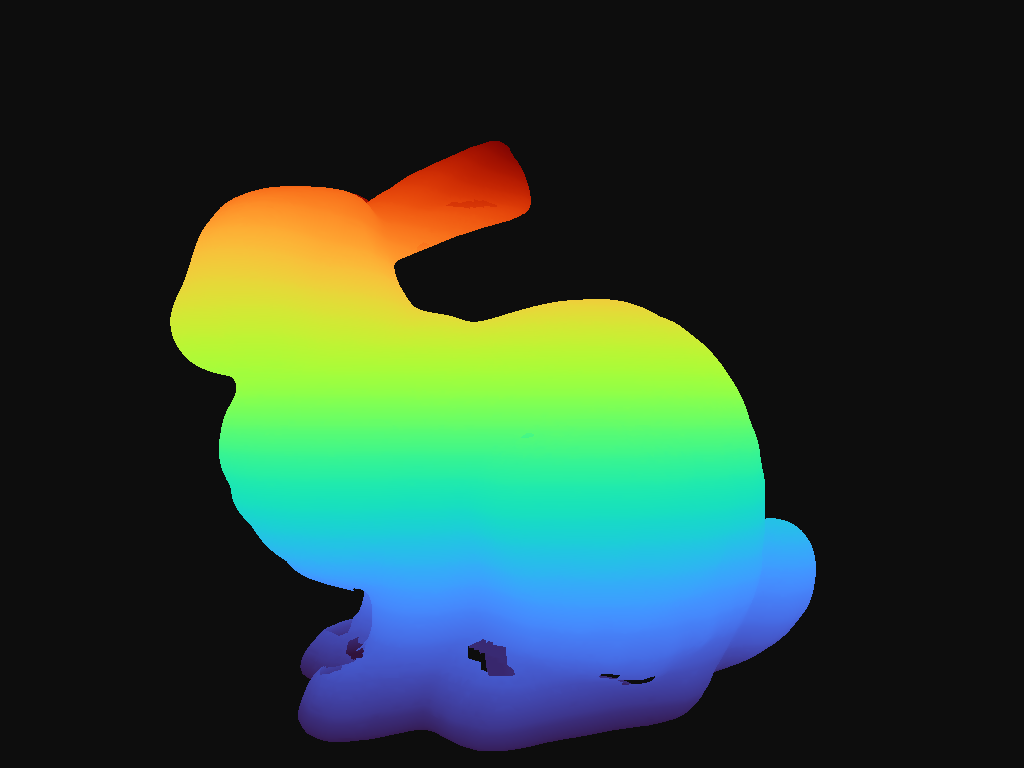
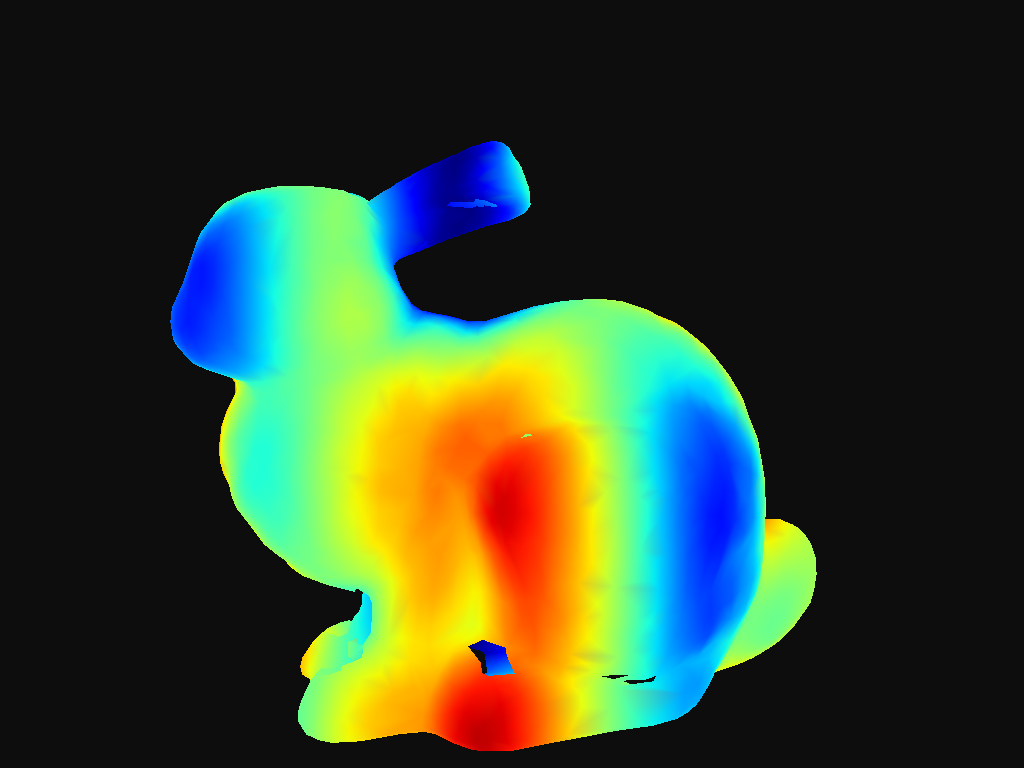


And in a nutshell, that’s the beauty of this field. It is visually stunning, mathematically rigorous, and computationally elegant. And above everything, fascinating enough to sustain a research area for nearly half a century now.
Thank you to everyone at SGI for this wonderful initiative and for facilitating my research experience this summer.

