Introduction
Swimming with a current feels effortless; swimming across it is exhausting — even over the same distance in meters. That asymmetry isn’t a fact about water, it’s a fact about which notion of “distance” you’re using. This week’s project builds exactly that idea into a triangle mesh: a metric that makes some directions cheaper to move through than others. Along the way we needed two core tools from discrete differential geometry — intrinsic triangulations and the anisotropic Laplacian — and had to make both of them survive a real 3D shark scan, not just a hand-drawn toy mesh.
Background
A quick glossary before the derivations:
- Mesh (V, F): vertex positions and the triangles connecting them.
- Halfedge: a directed half of an edge, belonging to one triangle; its twin is the matching half from the triangle on the other side. This lets code ask “what’s across this edge?” in constant time.
- Tensor field / metric S: a small symmetric, positive-definite matrix per triangle (2×2 in 2D, 3×3 on a 3D surface) describing how expensive movement is in each direction. S = I recovers ordinary Euclidean distance.
- Intrinsic triangulation: a different triangulation of the same surface, changing only connectivity — never vertex positions.
- Edge flip: the only move allowed — swap the diagonal of the quad formed by two triangles sharing an edge.
- Delaunay triangulation: every edge satisfies the empty-circumcircle property; avoids thin, needle-like triangles.
- Cotangent weight (wij): built from the two angles opposite an edge; decides both whether to flip it and what enters the Laplacian.
- Harmonic field: a function solving with fixed boundary values — “ink diffusing smoothly” between two fixed points.
Method: Intrinsic Triangulations
An intrinsic triangulation keeps a mesh’s lengths and angles — what an ant walking on the surface could measure — while reconnecting vertices via edge flips:
  i                 i
 /|\               / \
/ | \             /   \
m |  k   ====>   m --- k
\ | /             \   /
 \|/               \ /
  j                 j
This matters because it can fix badly-shaped triangles without adding a single vertex — useful whenever an algorithm only needs lengths and angles, not raw coordinates.
The special case is the Delaunay triangulation, equivalent to:
The proof is short: , and since the denominator is always positive — so the sign of wij depends only on sin(α+β). Empty-circumcircle and angle-sum are the same condition. In code, this is a queue: flip any edge with negative weight, re-check its neighbors, repeat until none remain.
Method: The Anisotropic Laplacian
To make distance direction-dependent, attach a metric M to each triangle: . M must be symmetric (for real eigenvalues/perpendicular axes) and positive-definite (so no length comes out negative or imaginary).
The pleasant surprise: the Delaunay proof above never used Euclidean angles specifically — only that they’re triangle angles in (0°,180°). Measuring α,β with M instead, the same algebra holds, so the criterion is unchanged in form. On a fixed test quad, switching S from identity to diag(1,16) flips the verdict entirely (w: +0.72 → -1.37) — same vertices, different verdict on whether the edge should exist.
The same assembles the Laplacian (, ), which must satisfy: rows sum to zero, symmetric, constants in the kernel. When all (i.e., Delaunay), also satisfies the maximum principle — solutions to extremize only on the boundary. That guarantee is the entire reason the flip exists before building anything on top of .
Implementation
The build order, including what broke:
Synthetic 2D test bed: HalfedgeMesh with flip_edge/flip_to_delaunay, validated on a hand-built non-Delaunay quad and a randomly-scrambled disc.
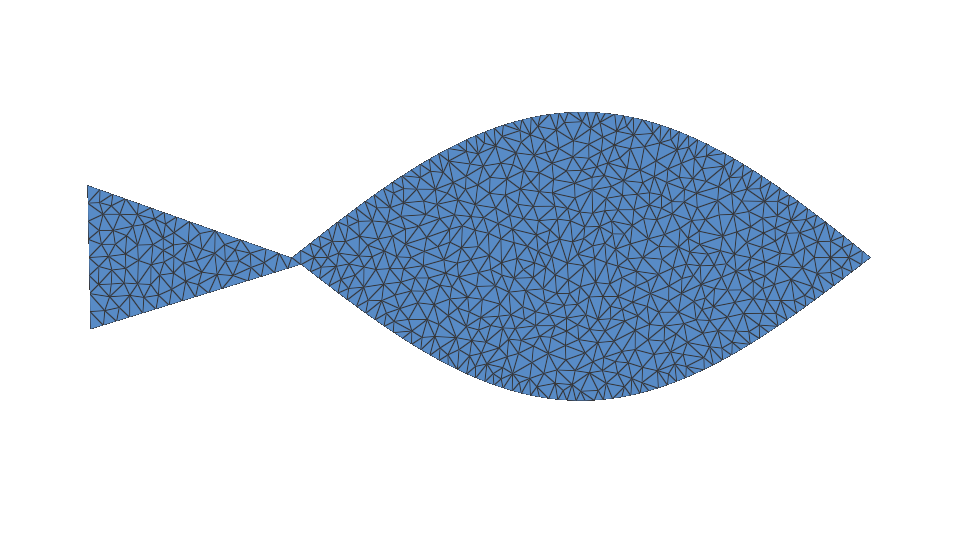
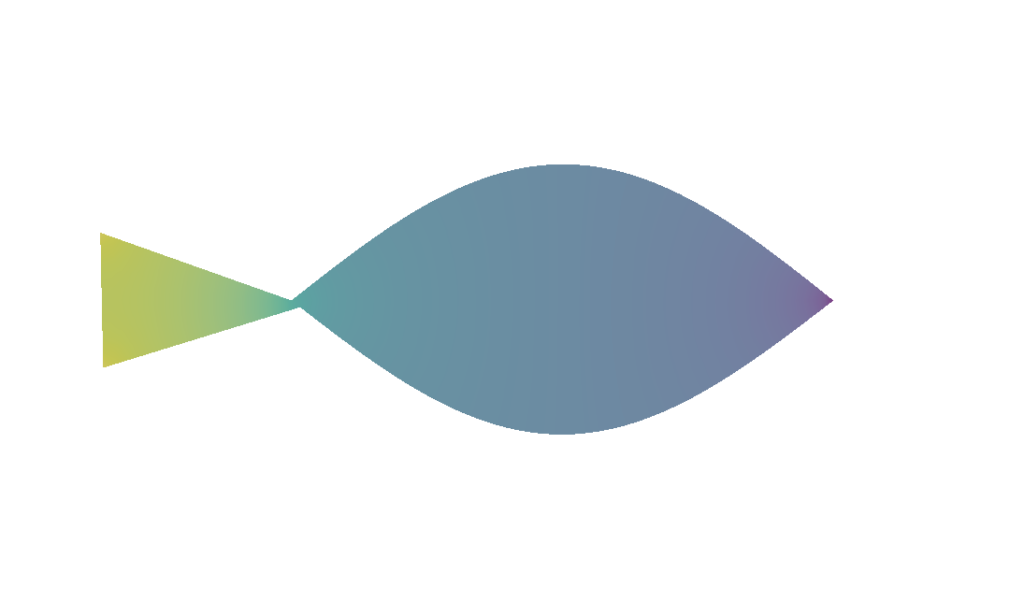
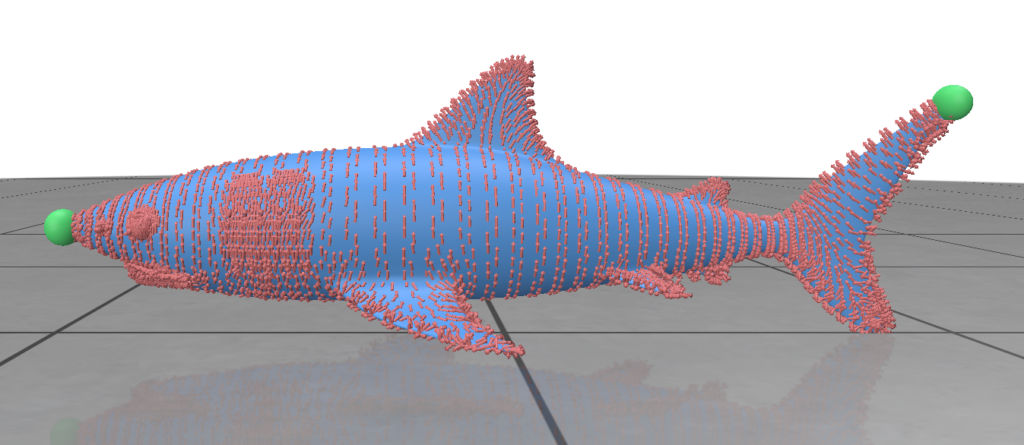
Toy 2D fish: solved a harmonic field (nose=0, tail=1) with the ordinary Laplacian, took its per-triangle gradient as the “body direction” , and built , — cheap along the body, expensive across it.
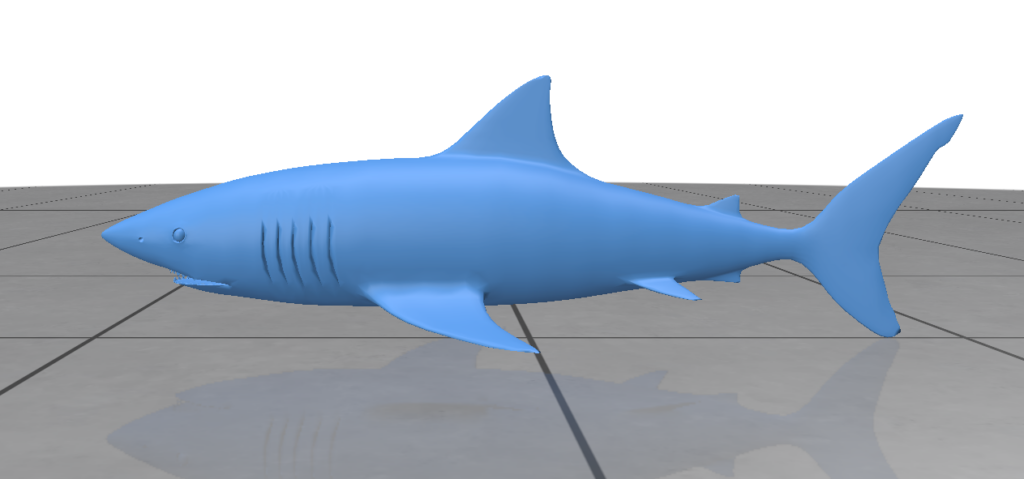
Real 3D shark scan — the actual porting work:
Cleanup: weld coincident vertices, drop degenerate (zero-area) faces, since these send cotangent weights to nan and corrupt connectivity.

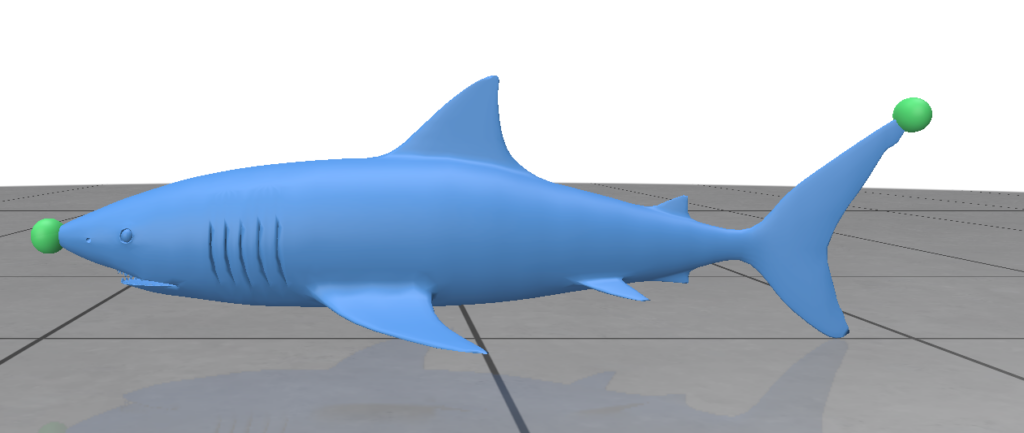
Automatic nose/tail: SVD on centered vertices finds the principal axis; nose and tail are its two extremes.
A genuinely 3D gradient: no single “perpendicular” exists on a surface, so the normal and cross product replace 2D rotation: , and the tensor grows to 3×3 with a transverse direction .

Hardening the flip queue: index by (face, corner) instead of hashing mutable Halfedge objects; return None instead of nan for degenerate triangles; reject flips that would duplicate an existing edge.
Results
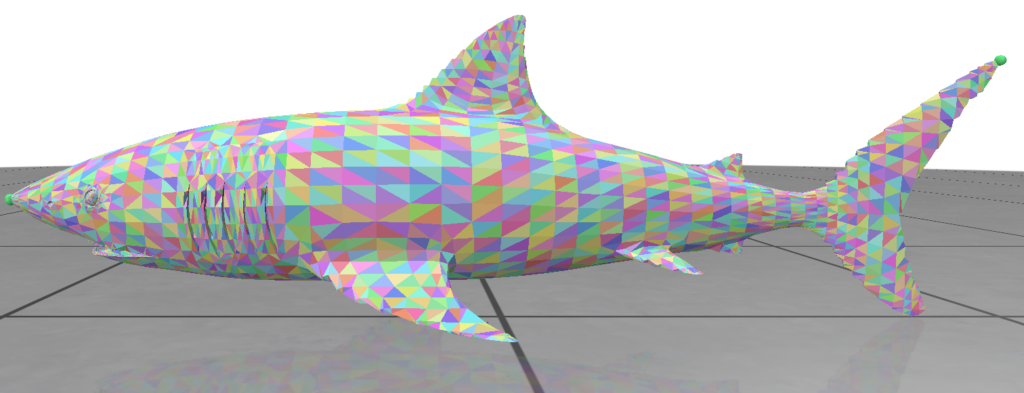
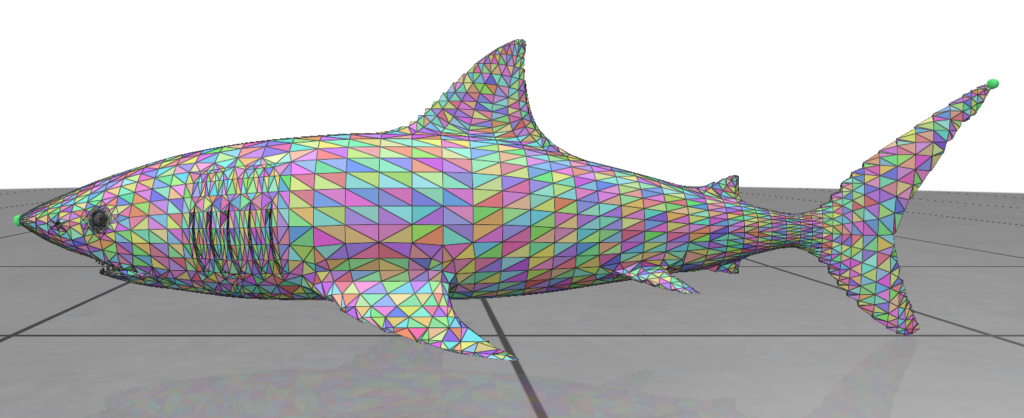
The Polyscope UI toggles between the original mesh and the re-triangulated one, with a live counter of non-Delaunay edges before/after and total flips performed. Recomputing the direction field after flipping shows the payoff: geometry never moved, but connectivity reorganized to better respect the metric — the field still tracks the shark’s body, now on better-conditioned triangles.
