By Evelyn Zhu, Mentor: Alvin Shi,
Have you ever wondered what 4D actually looks like? I do, I have always imagined what will 4D world looks like, and in this project I was able to take a small peak at this enigmatic world.
But before I show you, there’s one thing I need to introduce first. Here’s the problem: we live in three dimensions. Our eyes, our screens, our intuition are all 3D. A four-dimensional object simply doesn’t fit into the world we’re able to look at. So how could we possibly “see” one?
The trick is to translate between dimensions. There are two operations that do exactly that: one to build a dimension up, and one to peek a dimension down. They’re called extrusion and slicing, and once you have them, 4D stops being impossible to picture [1].
Extrusion: building a dimension up
Extrusion is something you already know, even if you’ve never called it that. Take a shape, make a copy, drag the copy along a brand-new direction, and fill in everything it sweeps through. A point dragged becomes a line. A square dragged becomes a cube. And a 3D object dragged along a fourth axis becomes a genuine 4D object (See figure 1).
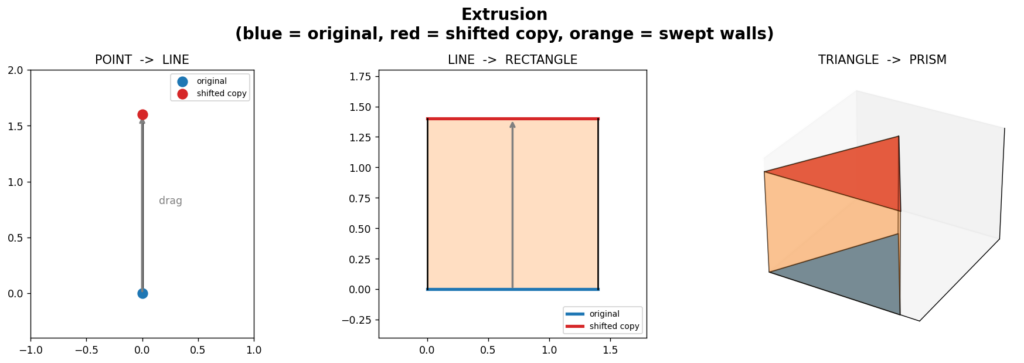
Every rung of that ladder climbs one dimension. The secret is the direction you drag: as long as it points along a fresh axis the shape wasn’t already using, you gain a dimension. Drag a cube in a direction perpendicular to width, height, and depth all at once — a direction we can’t even point at and we’vejust built a shape in 4D.
Slicing: peeking a dimension down
Slicing is the opposite move. Instead of building up, we cut across. Pass a flat plane through a solid, and where it cuts, you get a cross-section one dimension lower. Slice an 2D triangle, you get a line segment; slicing a 3D cube, you will get a 2D square (see figure 2).
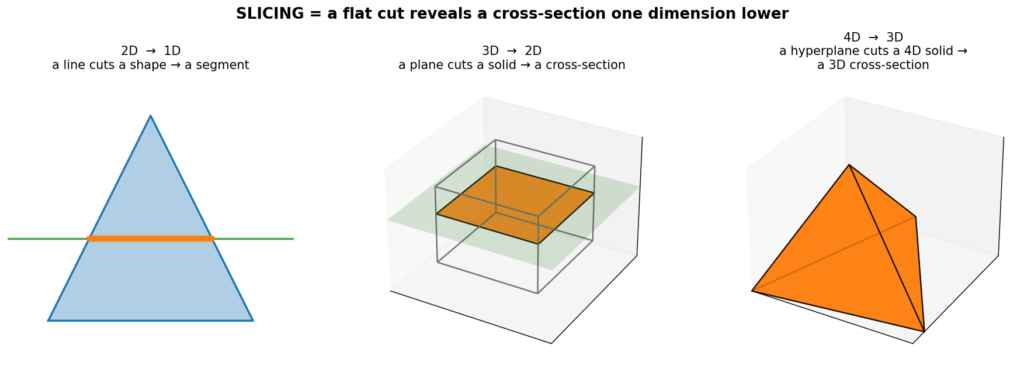
Now push that one rung higher: if we slice a 4D object with a “flat 3D plane” (a hyperplane), and the cross-section is a 3D shape, and this is finally something we can look at. That’s the whole idea. We can’t see the 4D object directly, but we can see its 3D slices.
Putting it together: watching 4D
So here’s how we can actually “see” 4D object in our 3D world. We take a 4D objects and we slice it (1 dimension down). One slice gives one 3D snapshot. But a single snapshot isn’t enough to feel a 4D shape, so we do something more: we slowly rotate the object through the fourth dimension and re-slice it at every step.
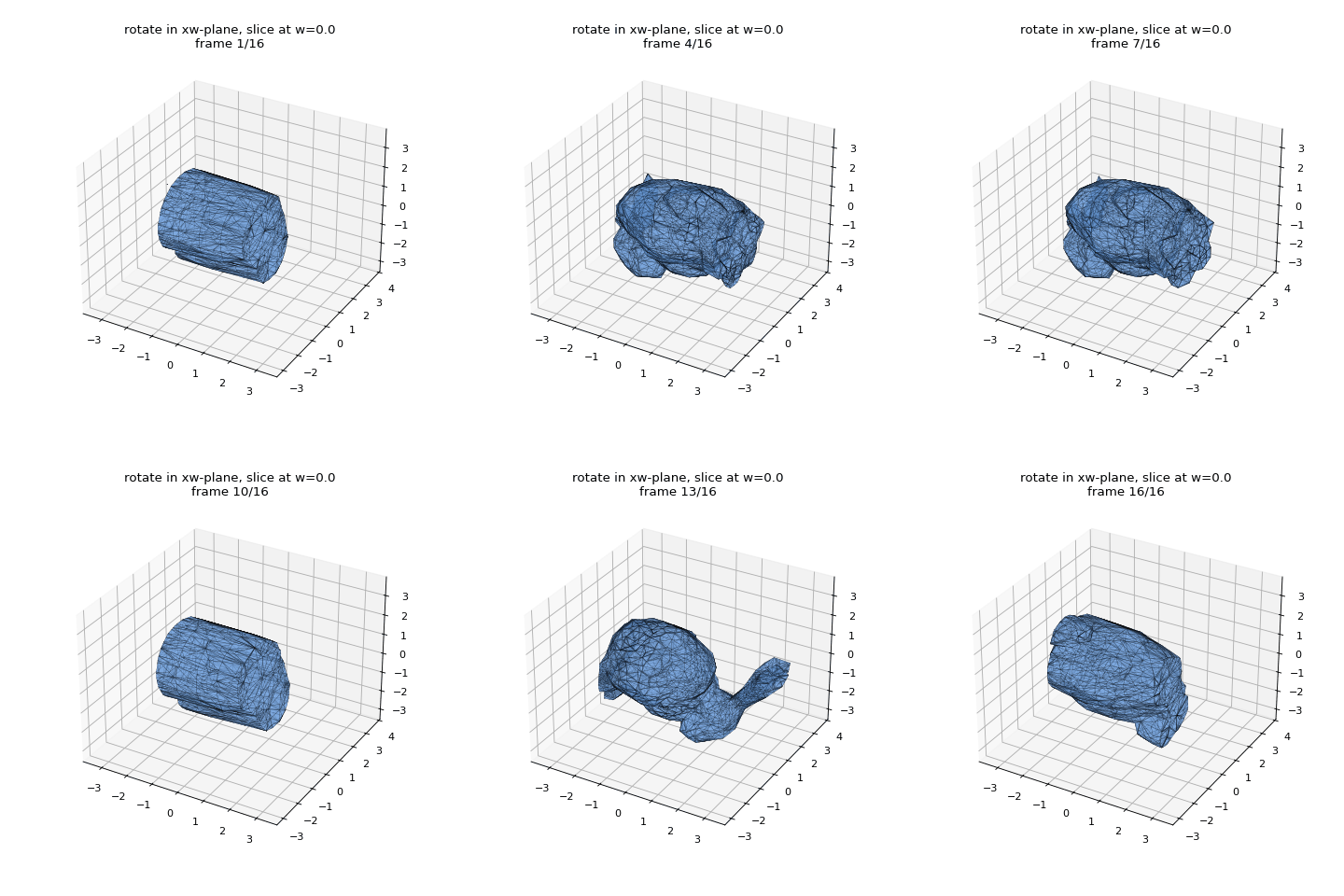
Here’s exactly what you’re looking at, step by step:
- The object is 4D version of the stanford bunny. Every one of its points has four coordinates: the usual x, y, z, plus a fourth one we’ll call w. We can’t display it directly, because w points in a direction our world doesn’t have.
- We fix w and take the cross-section. Holding w at a single value, we ask: which parts of the object live exactly there? That set of points forms a 3D shape — one slice. This is the slicing operation, applied to every little piece of the object and stitched together into the shape you see.
- We rotate in 4D. Between frames, we turn the object by a small angle in a plane that involves w (here, the xw-plane). This is a true four-dimensional rotation, and it tips parts of the object that were “elsewhere along w” toward our fixed slice.
- We re-slice, and repeat. Because the rotation carries new material through the slice, each frame’s 3D cross-section differs from the last. Play the frames in sequence and the shape appears to be growing, shrinking, splitting, and merging.
And this is the whole magic trick: we use extrusion to build a 4D object from 3D object then slicing to see it. Two simple moves and now a dimension we were never supposed to be able to view suddenly becomes something we can sit back and watch.
References
[1] Alvin Shi, Haomiao Wu, and Theodore Kim. 2025. Hyper-Dimensional Deformation Simulation. In ACM SIGGRAPH 2025 Conference Papers. ACM. https://doi.org/10.1145/3721238.3730730
